



How to use AI for marketing your business: seven practical uses, what to keep human, and a simple first-month plan so AI saves time without hurting quality.
Have you opened ChatGPT, typed "write me a marketing plan", and ended up with something any competitor could have copied?
You're not alone. According to a Thryv survey of 561 U.S. small business owners, fielded in April 2026, 66% now use AI, up from 55% a year earlier. Yet 70% of owners say they need more training to use it well.
Sound familiar? Everyone is using the tool. Few people have a plan for it.
This guide gives you the plan: seven marketing jobs where AI earns its keep, the parts you should never hand over, and a simple way to start this month.
Key Takeaways
- AI works best as a fast first-draft and analysis assistant for one specific marketing job, not as a replacement for your strategy or your voice.
- Start with one use case, such as research or email drafts, and measure time saved before you add a second tool.
- Google says publishing AI content at scale without adding value can break its spam policy, so every page still needs a human to check and improve it.
- Customer research, offers and final approval stay with you, because AI predicts likely wording and can state wrong facts with total confidence.
- Judge AI by outcomes you can count: hours saved, leads, replies and sales, not by how much content it produces.
How Do You Use AI for Marketing Your Business?
The short version: pick one repeatable marketing task, give AI your real customer details and examples, let it produce a first draft or analysis, then edit and check it yourself. Repeat that for research, content, email, ads, SEO, reporting and customer replies, one at a time, and track what it saves you.
That's the whole method. The rest of this post shows where it works and where it doesn't.
Why Small Businesses Are Moving to AI Now
The reason is mostly time. The same Thryv survey found that 92% of AI users say it saves them time, mostly on repetitive tasks, and 70% say it increased their revenue over the past year. 55% say it cut costs.
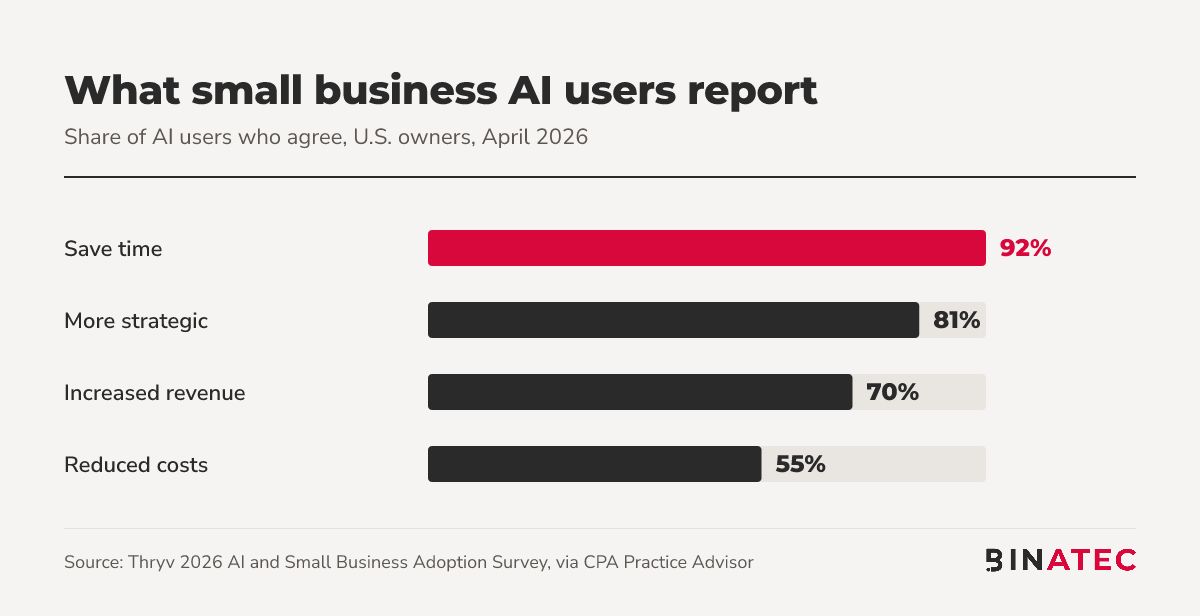
One caution. Thryv sells AI-enabled marketing software, so treat the numbers as owners' own opinions, not audited results. They still show where the value is: time first, then clearer thinking.
Marketing is also where small firms start. The U.S. Chamber of Commerce, as summarised by Capsule, reported in August 2025 that 54% of small businesses use AI marketing tools and another 27% plan to within 12 months.
7 Ways to Use AI for Marketing Your Business
1. Research Your Customers and Competitors
This is the safest place to begin. Paste in your own customer reviews, support emails and sales call notes, and ask AI to group the questions, objections and words people use. You get a customer language map in an hour instead of a week.
GoDaddy suggests using AI to gather insight on competitors, your audience and your industry before you set a strategy. Check any claim it makes about a competitor against their real website. Our guide to competitor analysis shows how.
2. Draft Content You Then Make Your Own
Ask for outlines, first drafts and headline options. Don't publish the draft as it comes.
Google's guidance on generative AI content is blunt: using AI to generate many pages without adding value may violate its spam policy on scaled content abuse, and it calls it critical to manually fact-check and review AI output. Add what only you have: your pricing, your process, real photos, real customer questions.
3. Personalise Your Emails
Give AI a segment (new subscribers, past buyers, quote requests that went quiet) and ask for three subject lines and a short follow-up for each. You still choose the offer and send time.
A Mailchimp report cited by ClickUp says 88% of marketers believe their companies must increase AI and automation use to meet customer expectations. If you're building flows, our email marketing and marketing automation pages cover the setup.

4. Test More Ad Variations
Paid ads need many headlines and descriptions. AI can produce twenty options from one brief. You cut them down to the five that are honest and on-brand, then let the platform test them.
Keep claims you can prove. If AI writes "voted best in town" and you weren't, delete it. Our Google Ads team builds this review step into every account.
5. Speed Up SEO Research
Use AI to cluster keyword lists, suggest the questions customers ask, and spot gaps in an existing page. Don't use it to churn out hundreds of thin pages.
Pages that answer a real question well still win. Start with our guide to getting cited by ChatGPT if AI search is on your list.
6. Make Reporting Faster
Export your numbers and ask AI to summarise what changed and what to check next. That turns a Monday-morning spreadsheet slog into a 10-minute review.
Always spot-check the maths. If a figure looks odd, open the source report before you act on it.
7. Handle Routine Customer Questions
Chat assistants and reply drafts can answer opening hours, delivery times and booking questions. Hand anything about money, complaints or special cases to a person.
AI for Marketing in Action: A Quick Example
Picture a local home services company that wants more quote requests. It pastes 40 past reviews into an AI tool and asks for the top five reasons customers chose them. The answer: fast replies and clear pricing.
That becomes one rewritten landing page headline, one follow-up email for quotes that went quiet, and a monthly summary of calls and form fills. Three small jobs, one afternoon, and the owner reviews all of it before it goes live.
That's the pattern: real customer input in, a draft out, a human decision before anything is published.
What to Keep Human
Keep these in your hands:
- Positioning and offers: AI will give you the average of what's already out there.
- Facts and claims: models predict likely words, so they can state wrong details smoothly.
- Private data: don't paste customer personal details or confidential numbers into public tools.
- Final approval: nothing goes live that you haven't read.
When AI Is the Wrong Tool
AI won't fix a weak offer, a slow website or unclear targeting. It makes whatever you already do faster, good or bad.
If your site doesn't convert, start with conversion rate optimization before you make more content. More traffic into a leaky page just wastes more money, faster.
A Simple First-Month Plan
- Week 1: Pick one task that eats your time. Note how many hours it takes now.
- Week 2: Run it with AI using real customer details. Edit everything.
- Week 3: Compare hours, quality and results. Keep what works, drop what doesn't.
- Week 4: Add one more use case, or bring in help to build it properly.
The 70% of owners who say they need training have the right instinct. A short, structured trial beats installing five tools at once.
FAQs
What is the best way to use AI for marketing?
Use it for first drafts and analysis on one repeatable task, like customer research or email follow-ups. Give it real customer details, then edit the result yourself. Start small, measure hours saved, and add a second use case only after the first one works.
Can AI replace a marketing team?
No. AI speeds up drafting, sorting and reporting, but someone still has to choose the audience, the offer and the message, and check the facts. Most owners get the best results when AI supports a person who understands the business.
Will Google penalise AI-written content?
Google says AI content isn't banned by itself, but generating many pages without adding value may break its spam policy on scaled content abuse. It also advises you to manually fact-check and review AI output. Quality and usefulness are what matter.
Is it safe to put customer data into AI tools?
Be careful. Avoid pasting names, emails or payment details into public tools. Remove personal details first, check each tool's data policy, and use a business plan with privacy controls when you handle anything sensitive.
Conclusion
AI is a very fast assistant, not a strategy. The businesses getting value from it pick one job, feed it real customer detail, and review everything before it goes out.
This week, choose one task that drains your time and run the four-week test above. If you'd rather have it set up properly, look at our AI consulting and AI integration services, or get a free quote and tell us where your hours go.
Sources
- AI Adoption Continues to Rise, But 70% Say They Need More Training (Thryv survey)
- Small business AI adoption statistics (Capsule, citing U.S. Chamber of Commerce)
- Google Search Central: Using generative AI content
- GoDaddy: Incorporating AI into your small business marketing strategy
- ClickUp: How to use AI for marketing


John Doe
Supreb Information. Thanks
15 July 2014 View replies . 1