



Wondering how to get more customers for your small business? Nine practical ways, from referrals to Google Business Profile, and which to start with this week.
Have you tried posting more, boosting a few ads and handing out discount codes, only to see the same handful of customers come back?
You're not short of effort. You're probably spreading it across too many places at once, and none of them gets enough attention to work.
Sound familiar?
To get more customers for your small business, start with the people who already know you, then make it easy for strangers to find and trust you. Ask happy customers for referrals, complete your Google Business Profile, answer every enquiry fast, and only then pay for ads or build new channels.
Below are nine ways to do that, in the order I'd try them, with the numbers behind each one and a clear sense of when to skip it.
Key Takeaways
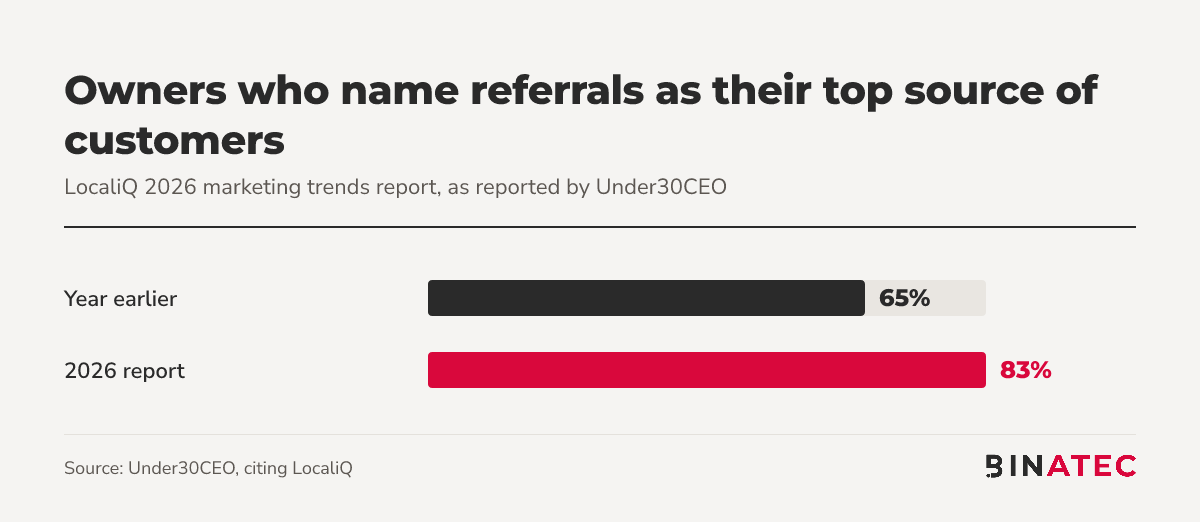
- In a 2026 LocaliQ report, 83% of small business owners named referrals as their top source of new customers, up from 65% a year earlier.
- Google says businesses with complete, accurate profiles are more likely to appear in local search results, and reviews feed its prominence signal.
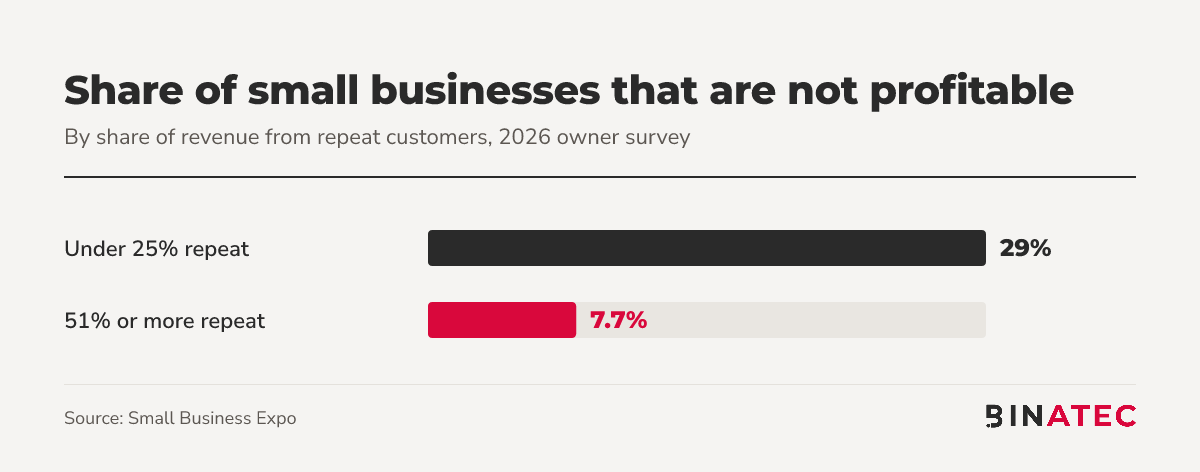
- One 2026 owner survey found only 7.7% of businesses with mostly repeat revenue were unprofitable, against 29.0% of those with little repeat revenue.
- A study of a German bank found referred customers were worth at least 16% more than similar customers who found the bank another way.
- Fix the cheap, fast things first: referrals, your Google listing and enquiry follow-up. Paid ads work best once those are in place.
Step 1: Ask Your Best Customers for Referrals
Referrals are the cheapest customers you'll ever win, and most owners never ask for them.
LocaliQ's 2026 marketing trends report, as relayed by Under30CEO, says 83% of small business owners name referrals as their top acquisition source. That's up from 65% a year earlier. The same report puts digital advertising at 46%. The article doesn't share the sample size, so treat the exact figures as a direction rather than a measurement.
Here's the simple way to ask:
- Pick your 10 happiest customers, the ones who've thanked you or bought twice.
- Message each one personally within a day of a good moment, such as a delivered job or a compliment.
- Ask for one specific introduction: "Do you know one other business owner who has this problem?"
- Make passing you on easy with a short message they can forward, or a link they can share.
- Thank every referrer, even when the lead doesn't buy.
Referred customers also tend to be worth more. A Journal of Marketing study of a German bank found the average referred customer was worth at least 16% more than a comparable customer who wasn't referred. It's one bank, so don't expect the same gap in your shop. The direction is still a good reason to ask.

Step 2: Complete Your Google Business Profile
If you serve a local area, this is the free listing that decides whether nearby customers find you or your competitor.
Google's own help page says local results are based on relevance, distance and prominence. It also says businesses with complete and accurate information are more likely to show up in local search results, and that there's no way to pay for a better local ranking.
That makes this a job you can finish in an afternoon:
- Claim and verify the profile so Google knows you're the real owner.
- Choose the most accurate main category, then add the services you actually sell.
- Fill in your address (if customers visit), opening hours and phone number.
- Add real photos of your premises, your team and your work.
- Keep hours up to date, especially around holidays.
Want help with the rest? Our guide to improving your local SEO ranking walks through the map pack in detail, and our local SEO service covers it end to end.
Step 3: Collect Reviews and Show Them Off
Google says prominence is partly based on how many reviews you have and how many websites link to you. Reviews also do a second job: they calm the nerves of a stranger who's deciding whether to trust you.
Ask at the moment the customer is happiest, not weeks later. Send a direct link to your review page by text or email, and reply to every review you get, good or bad. Then put your best reviews on your homepage and your service pages.
Step 4: Answer Every Enquiry Within a Day
This one costs nothing, and it quietly beats most marketing.
Every lead you paid for, or earned through a referral, is a customer you lose the moment they wait three days for a reply. Set a rule: every call, form and message gets a human answer within a working day, ideally within hours.
If you can't keep that rule, a simple auto-reply that says when you'll respond is better than silence. Follow up once more a few days later if they go quiet. That second message wins back more customers than most owners expect.
Step 5: Turn First-Time Buyers Into Repeat Customers
Getting more customers doesn't always mean finding new ones. A customer who buys again is the cheapest sale you'll make.
A 2026 survey of more than 1,100 owners from the Small Business Expo, as summarised in search results, found that 29.0% of businesses getting under 25% of revenue from repeat customers weren't profitable. Among businesses getting 51% or more from repeat customers, only 7.7% weren't. That's a correlation from a self-selected survey, not proof that repeat buyers cause profit. It does line up with common sense.
Simple ways to bring people back: a thank-you message a few days after purchase, a reminder when they're likely to need you again, and a small reason to return, such as early access or a loyalty perk.
Step 6: Build an Email List You Own
Social platforms change their rules and reach whenever they like. An email list doesn't.
Offer something useful in exchange for an address: a buying guide, a checklist, a first-order perk. Then send one helpful message a fortnight, with a clear next step. Our email marketing service can set up the basic welcome and follow-up emails so they run on their own.
Step 7: Make Your Website Convert the Visitors You Already Get
Before you pay for more traffic, check what happens to the traffic you have. If 100 people visit and two enquire, doubling the traffic gets you four. Fixing the page can get you more without spending a penny on ads.
Look at your top three pages. Is it obvious what you sell, who it's for and what to do next? Is there one clear button? Is there proof, such as reviews or examples, near it? Our guide to improving landing page conversion rate shows the usual fixes, and our conversion rate optimisation service goes deeper.

Step 8: Partner With a Business That Shares Your Customers
A wedding photographer and a florist both want brides. A bookkeeper and a business lawyer both serve new founders. Neither competes with the other, and each trusts the other's work.
Pick two or three businesses like that near you. Offer to recommend them, share a joint offer or co-host a small event. It's slow to set up and very cheap to run.
Step 9: Test Paid Ads on High-Intent Searches
Ads are the fastest way to get in front of strangers, but they also punish a leaky funnel. That's why they sit last.
Start with search ads for people already looking for what you sell, such as "emergency plumber near me" or "bookkeeper for small business". Keep the budget small, send clicks to one focused page, and track calls and form fills, not just clicks. Our Google Ads management service can run this for you, and our guide to advertising a small business locally covers more options.
A Quick Example: One Month, Three Moves
Say you run a local cleaning company with a thin Google listing and no referral habit. Here's how a focused month could look. This is an illustration, not a client result.
- Week 1: Complete and verify the Google Business Profile, with photos and services.
- Week 2: Message your 10 best customers for a review and one introduction each.
- Week 3: Set the reply rule: every enquiry answered within hours.
- Week 4: Add a short thank-you and rebooking email for past customers.
None of that costs ad spend, and each step makes the next one work harder.
Where This Advice Breaks Down
Referrals and local listings work best when you serve a defined area or a small circle of buyers. If you sell a new product that nobody is searching for yet, you'll need to create demand first, so paid ads, content and partnerships matter sooner.
The same goes if your service has a long sales cycle. A referral might take months to turn into a contract, so track leads and conversations, not only sales. And if you can't deliver good work to the customers you already have, fix that before chasing more. A fast-growing list of unhappy customers makes things worse.
If you're unsure who you're really trying to reach, start with our guide to defining your ideal customer profile.
FAQs
What is the fastest way to get more customers?
The fastest free way is to ask your happiest customers for a specific introduction and to answer every open enquiry today. If you need leads within days, a small search-ad test is the quickest paid route, as long as your website can convert the clicks.
How do I get more customers with no money?
Use the free steps: ask for referrals, complete your Google Business Profile, collect reviews, follow up on every enquiry and partner with a neighbouring business. They cost time instead of budget. Our guide to starting a business online with no money covers the wider picture.
How do I get more customers online?
Make sure people can find you, with a complete Google Business Profile and a clear website. Then give them a reason to trust you, such as reviews and examples, and a simple next step. Add email and search ads once those basics convert.
Does social media get you more customers?
It can, but it works best as a place to build trust, not a quick fix. The LocaliQ report relayed by Under30CEO says 58% of owners call social their most important channel. Pick one platform where your buyers actually spend time rather than posting everywhere.
How long does it take to get more customers?
Referrals and faster replies can show results within days. Google listing and review gains usually take weeks. Paid ads can bring leads within days, but need weeks of testing to turn profitable. Content and SEO take longer, often several months.
Conclusion
The idea to remember: win the people who already know you first, then make yourself easy to find and trust. Strangers come after that.
This week, send ten personal messages asking happy customers for one introduction, and spend an hour completing your Google Business Profile. Those two moves cost nothing and set up everything else.
If you'd like a second pair of eyes on which channel to push next, we're happy to look at your setup. You can get a free quote whenever it suits you.
Sources
- Under30CEO: Small Business Marketing in 2026, Where Customers Come From (citing LocaliQ)
- Google Business Profile Help: Improve your local ranking on Google
- Schmitt, Skiera and Van den Bulte: Referral Programs and Customer Value, Journal of Marketing (2011)
- Small Business Expo: Repeat customers and profitability survey


John Doe
Supreb Information. Thanks
15 July 2014 View replies . 1