



Wondering how to advertise a small business locally without wasting money? Start with the free basics, then add the paid and offline tactics that pay back.
You've got a good business, a decent location and customers who love you. So why do so many people nearby still not know you exist?
Most small business owners try a bit of everything: a flyer here, a boosted post there, a few weeks of ads that get switched off when the bill arrives. Sound familiar?
The problem isn't budget. It's order. Local advertising works when you fix the free basics first, then pay to reach the people who are already close to buying.
This guide gives you nine ways to advertise a small business locally, in the order I'd do them, with what each one costs you in time or money.
Key Takeaways
- Fix your Google Business Profile and collect reviews before you spend a pound or dollar on ads, because that's where local customers look first.
- Google ranks local results on relevance, distance and prominence, and its own help page says you can't pay for a better local ranking.
- Reviews now decide who gets the call: 97% of consumers read them and 47% won't use a business with fewer than 20.
- Radius targeting in Google Ads needs at least 1 km, and very small radii can mean your ads barely show.
- Pick one free channel, one paid channel and one offline channel, then track which one brings real enquiries before adding more.
What Is Local Advertising?
Local advertising means promoting your business to people in the area you actually serve: a town, a postcode, a radius around your shop or van. It mixes free visibility (your Google listing, reviews, community presence) with paid reach (local search ads, geo-targeted social ads, print and sponsorships).
The short version: claim and complete your Google Business Profile, earn reviews, run a tightly targeted ad on Google or Meta, and show up in your community. Do those four and you've covered what most local customers will ever see.

1. Fix Your Google Business Profile First
When someone searches "plumber near me" or "best bakery in Leeds", your Business Profile is often the first thing they see. According to Google's Business Profile help, local results rely mainly on three things: relevance, distance and prominence.
Relevance is how well your profile matches the search. Distance is how far you are from the searcher. Prominence is how well-known you are, which Google says depends partly on how many reviews you have and how many websites link to you.
Here's the part owners miss. Google states there is "no way to request or pay for a better local ranking." So this one is free, and no agency can buy it for you.
Do this in an afternoon:
- Claim and verify your profile.
- Choose the most accurate primary category.
- Add opening hours, services, your service area and a phone number that gets answered.
- Upload real photos of your premises, team and work.
- Post an update or offer every couple of weeks.
We go deeper on the ranking side in our guide to improving local SEO ranking, and if you'd rather have it handled, that's what our local SEO service is for.
2. Collect Reviews on Purpose
Reviews are your cheapest advertising and your biggest trust signal. BrightLocal's 2026 Local Consumer Review Survey, of 1,002 US adults, found 97% of consumers read reviews for local businesses.
The bar is higher than you might think. The same survey found 47% won't use a business with fewer than 20 reviews, 31% will only use one rated 4.5 stars or higher, and 74% care only about reviews from the last three months.
That means reviews are a habit, not a one-off push. Ask every happy customer, the same day, with a direct link to your Google review page. And reply to the reviews you get: 89% of consumers expect owners to respond.
3. Show Up Where Customers Read Reviews Now
Where people look is shifting. BrightLocal found 71% of consumers use Google to read reviews, down from 83% a year earlier, while AI tools such as ChatGPT jumped from 6% to 45%.
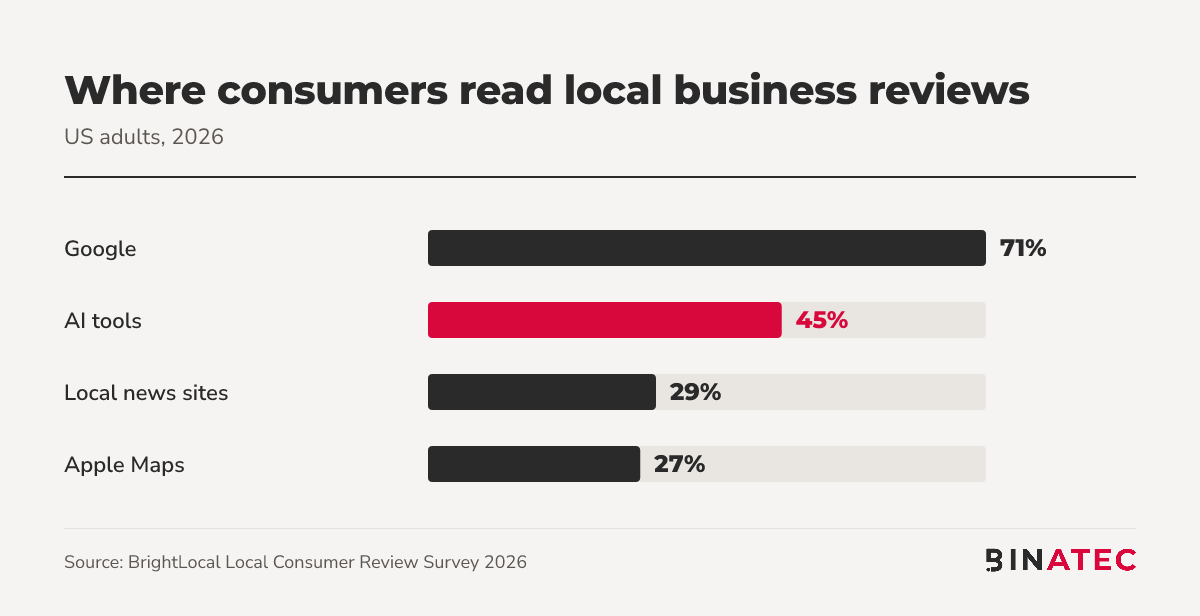
Practically, that means your name, address, services and reviews should match everywhere: your website, Google, Apple Maps and the directories people trust in your trade. Inconsistent details make you harder to recommend, by people and by AI.
Google is also moving to let AI talk to customers on your behalf, so keep your profile accurate. We covered that in Google's AI Will Answer Your Customers. Is Your Profile Ready?
4. Run Locally Targeted Google Search Ads
Once the basics are solid, paid search is the fastest way to reach people who are already looking. Someone typing "emergency electrician" is ready to hire, and a well-set-up Google Ads campaign can put you in front of them.
Targeting is where local budgets leak. According to Google Ads Help, radius targeting needs a radius of at least 1 km, and if you target a small radius, "your ads might only show intermittently or not at all."
Google also says broad location targeting ("Presence or interest") is its recommended best practice on Search, and suggests "Presence" only when you want to reach people physically in your locations. For a local trade or shop, check which one you've chosen before you launch.
Start small: one campaign, your top two services, your service area, a daily budget you can live with, and calls tracked as conversions.
5. Use Meta Ads to Reach Nearby People Who Aren't Searching
Search ads catch people who are ready now. Facebook and Instagram ads reach people who would buy if they were reminded you exist: a new cafe, a seasonal offer, a clinic opening a second site.
Keep the audience tight around your location, lead with one clear offer, and use a real photo of your place or team. Our Meta ads service covers the setup, but the rule is simple: one area, one offer, one action.

6. Check Local Services Ads If You Sell a Trade
If you're a plumber, locksmith, cleaner or another home-service business, Google's Local Services Ads put you at the top of results for your area. They come with a rule that catches people out: missed calls can cost you. See how missed calls now cost money in Local Services Ads before you switch them on.
7. Get Involved in Your Community
Offline still counts, especially for businesses that rely on trust. Sponsor a youth team, join your local chamber of commerce, swap referrals with nearby businesses, or run a stall at a local event.
These don't scale, but they build the name recognition that makes every other channel work better. Put a QR code on anything printed that leads to your Google review page or a booking page you can measure.
8. Build a Referral and Repeat-Customer Loop
Your existing customers are the cheapest audience you'll ever advertise to. Collect emails with permission, send a short monthly note with one useful tip or offer, and give people a reason to bring a friend.
A simple referral offer (a discount for both sides) beats most ad spend per customer, because the person arriving already trusts the person who sent them.
9. Add Local Social Content That Shows Your Work
Post short photos and videos of real jobs, products and people, and tag your location. Join local Facebook groups as a helpful neighbour, not a salesperson. If posting regularly feels like too much, our social media marketing team can run it.
Local Advertising in Action: A Simple 90-Day Plan
Here's how the order works for a hypothetical local business, say a salon, with a modest budget.
- Month 1: complete the Google profile, ask every client for a review, fix name and address details everywhere.
- Month 2: add one Google Search campaign for your two best services and track calls and bookings.
- Month 3: add a small Meta campaign for one seasonal offer, plus one community event or referral offer.
- End of month 3: keep what produced bookings and cut the rest.
When Local Advertising Isn't the Answer
If your service area is large or you sell nationally, local tactics will cap your growth. Likewise, if your website doesn't make it easy to call or book, more ads will just send more people to a dead end. Fix the site first.
And if you can't answer the phone or reply to enquiries quickly, no channel will rescue you. Speed of response is part of the advertising.
FAQs
What is the cheapest way to advertise a small business locally?
Claim and complete your Google Business Profile, then ask every happy customer for a review. Both are free, and Google says local ranking comes from relevance, distance and prominence, with reviews feeding prominence. Add community involvement and referrals next, which cost time more than money.
How much should a small business spend on local ads?
Start with a budget you can afford to test for 60 to 90 days, then judge by cost per enquiry, not clicks. Put the money into one campaign at a time. Scale what brings calls and bookings, and stop what doesn't.
Is Google Ads or Facebook Ads better for local business?
Google Ads usually comes first because it reaches people actively searching for what you sell. Facebook and Instagram ads work well for reminding nearby people about offers and new openings. Our comparison of Meta Ads vs Google Ads explains how to choose.
How do I advertise my business locally for free?
Use your Google Business Profile, ask for reviews, list your business in trusted directories, post on local social groups and swap referrals with nearby businesses. Keep your details identical everywhere. It takes consistent effort, but no ad budget.
Conclusion
Local advertising isn't about doing more. It's about doing the right things in the right order: profile, reviews, one paid channel, one community tactic.
This week, claim or tidy your Google Business Profile and send your last ten customers a review request. If you'd like help turning that into a plan that brings in customers, get a free quote from Binatec.
Sources
- BrightLocal Local Consumer Review Survey 2026
- Google Business Profile Help: Improve your local ranking
- Google Ads Help: Location targeting


John Doe
Supreb Information. Thanks
15 July 2014 View replies . 1