



Meta ads vs Google ads: compare 2025 costs, intent and results, see when each wins and how to choose the one to pay for first. Includes real benchmarks.
You're ready to spend on ads, and every agency blog tells you something different. Google, because buyers are searching. Meta, because it's cheaper. Both, because "you need a funnel." Sound familiar?
Here's the problem. Most Meta ads vs Google ads advice compares click prices as if a click on each platform were the same thing. It isn't. One reaches people who typed your service into a search box. The other reaches people who were scrolling and weren't looking for you at all.
This guide gives you a straight way to choose, the real benchmark numbers, a simple test budget and the point where running both starts to pay off.
The short answer: choose Google Ads when people already search for what you sell, because you're paying to appear at the moment of intent. Choose Meta Ads when your product is visual, impulse-friendly or unknown, because you're creating interest. Most growing businesses end up using both, in that order.
Key Takeaways
- Google Ads reaches people who are already searching, so it usually suits services and products with clear buying intent.
- Meta Ads (Facebook and Instagram) interrupts people who weren't looking, so it suits visual products, offers and brand awareness.
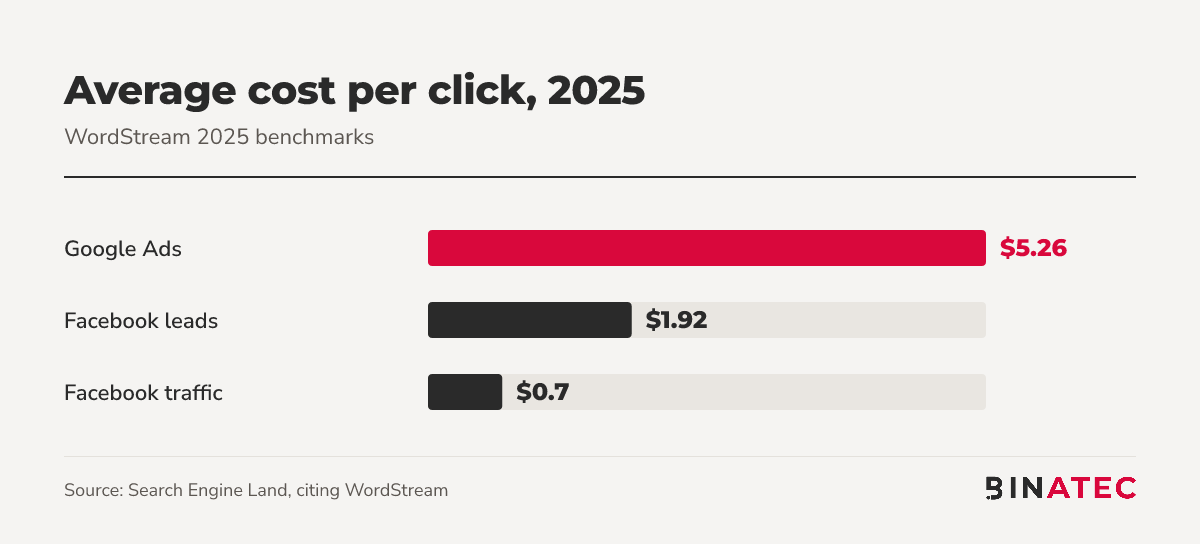
- WordStream's 2025 data puts the average Google Ads click at $5.26, against $0.70 to $1.92 on Facebook depending on the campaign goal.
- Cheaper clicks don't mean cheaper customers: judge each platform on cost per lead or sale, not cost per click.
- Start with one platform and a capped test budget, then add the second once you know your cost per customer.
- Your landing page matters as much as the platform, because both send paid traffic to the same page.
Meta Ads vs Google Ads: What's the Real Difference?
The difference is intent. With Google Ads, you bid on keywords, and your ad appears when someone searches for those terms. Google's own help page describes it this way: keywords are used to show ads when customers search for those terms or visit relevant websites.
With Meta Ads, you don't wait for a search. You choose an audience, a goal and a creative, and the ad appears in Facebook and Instagram feeds, Stories and Reels. Nobody asked for it.
That one difference shapes everything else: cost, creative, targeting and how fast leads arrive.

Side-by-Side Comparison
The quick version:
- Customer mindset: Google captures existing demand. Meta creates demand.
- Ad format: Google leans on text, shopping listings and video. Meta is built around images and short video.
- Targeting: Google targets what people search. Meta targets who people are and what they do.
- Speed to a sale: Google is usually faster for urgent needs. Meta is usually slower but reaches far more people.
- Creative effort: Google needs strong copy and a matching page. Meta needs thumb-stopping visuals and fresh variations.
What Do the Costs Actually Look Like?
Start with Google. WordStream's 2025 analysis put the average Google Ads cost per click at $5.26, up from $4.66 in 2024, with costs rising in 87% of industries. The average conversion rate for Google and Microsoft Ads was 7.52%.
Facebook is much cheaper per click. TheeDigital's summary of WordStream's 2025 data shows traffic campaigns at about $0.70 per click and lead campaigns at $1.92, with a 7.72% lead conversion rate.
So is Facebook the bargain? Not automatically.
A $0.70 click from someone casually scrolling is a different purchase from a $5.26 click from someone searching "emergency plumber near me." The searcher is far closer to buying. Compare cost per lead and cost per sale, never cost per click alone.
When Google Ads Is the Better Choice
Pick Google first if:
- People already search for your service (dentist, accountant, boiler repair, SaaS category terms).
- You need leads this month, not brand awareness over a year.
- You sell products with clear search demand and can run Shopping ads. See our Google Ads and shopping ads services.
- Your sales cycle is short and your offer is easy to explain in a headline.
Google rewards relevance. If your ads, keywords and landing page match, you pay less per click and win more. Our guide on how to improve Google Ads Quality Score shows how.
When Meta Ads Is the Better Choice
Pick Meta first if:
- Your product looks good (fashion, food, beauty, homeware, events, property).
- Nobody searches for you yet because the category is new or you're an unknown brand.
- You have an offer that works as an impulse buy, such as a discount, a free guide or a quiz.
- You want to build an audience you can retarget and email.
Meta also works for local and service businesses with a strong visual or video story. The catch is creative: ads wear out, so plan for fresh images and videos every few weeks. Our Meta Ads team builds that rhythm into every account.

Meta Ads vs Google Ads in Action: A Quick Example
Take two imaginary businesses. This is an illustration, not client data.
A plumbing company has customers who search "burst pipe repair" at 2am. Google puts the company in front of them at the exact moment of need. Meta would show the same ad to thousands of people with no leak. Google wins.
A new candle brand has no search volume, because nobody knows the name. A Reel showing the product being poured reaches people who'd love it but never thought to search. Meta wins, and Google can follow later once branded searches begin.
Most businesses sit between these two. That's why the next section matters.
Should You Use Both?
Often, yes, but not on day one. Running two platforms on a small budget means neither gets enough data to learn.
A sensible order:
- Launch on the platform that matches your customer's mindset (see above).
- Run it long enough to learn your cost per lead and cost per sale.
- Add the second platform once the first is profitable and you can spare budget.
- Use Meta to retarget website visitors and Google to capture people who search your brand after seeing you.
Make sure you can tell the platforms apart in your reports. If both claim the same sale, you'll overspend on one. Our channel attribution service fixes exactly that.
How Much Should You Test With?
There's no universal figure, and anyone quoting one is guessing. Work backwards from what a customer is worth.
A simple method:
- Work out the most you can pay for one customer and still make a profit.
- Multiply that by the number of customers you need to see a clear signal (many advertisers use at least 10 to 20 conversions).
- Set that as the test budget and a fixed test length.
- Judge by cost per lead or sale, not clicks or reach.
Google Ads also offers conversion lift tests once you have the volume, which separate sales your ads caused from sales that would have happened anyway.
Where This Advice Breaks Down
Benchmarks are averages across thousands of accounts, and your numbers will differ. Legal and finance keywords on Google cost far more than the average, while a niche local service might pay a fraction of it.
Other platforms may suit you better too. If you sell to B2B decision makers, LinkedIn Ads can beat both. If your buyers are under 25, TikTok deserves a test. And if your landing page is weak, no platform will save you. Fix the page first with conversion rate optimization.
FAQs
Is Meta Ads or Google Ads better for small businesses?
Neither wins everywhere. Google Ads usually suits small businesses whose customers already search for their service, such as trades, clinics and professional firms. Meta Ads suits visual products and brands that need awareness. Pick the one that matches how your customers find you, then add the other.
Is Meta Ads cheaper than Google Ads?
Per click, yes. WordStream's 2025 data puts the Facebook click at $0.70 to $1.92 against $5.26 on Google. But searchers are closer to buying, so cost per lead and per sale is the fairer comparison. Track both before you decide which is cheaper for you.
Can I run Meta Ads and Google Ads together?
Yes, and many businesses should. Meta builds awareness and retargets visitors, while Google captures people searching for you. Start with one platform so each gets enough data to learn, then add the second once you know your cost per customer.
Which platform gets leads faster?
Google usually does, because it targets people who are already looking and ready to enquire. Meta can generate leads quickly with a strong offer, but it often needs more testing of creative and audiences before results settle.
How much do Google Ads cost compared with Facebook Ads?
WordStream's 2025 averages show Google Ads at $5.26 per click and about a 7.52% conversion rate. Facebook lead campaigns averaged $1.92 per click and a 7.72% conversion rate. Your real costs depend on your industry, location, competition and offer.
Conclusion
The Meta ads vs Google ads question comes down to one thing: is your customer searching, or do you need to find them? Start where your customer is, measure cost per customer, and add the other platform when the first one works.
This week, write down the most you can afford to pay for one customer. That single number tells you which platform to test first.
If you'd like a second opinion, get a free quote and we'll help you choose, set up and measure the right mix.
Sources
- Search Engine Land: Facebook ad costs jump 21% in 2025, but still beat Google
- Search Engine Land: Google Ads costs rising but conversion rates improved in 2025
- TheeDigital: 2025 Facebook Ads Benchmarks
- Google Ads Help: About Google Ads


John Doe
Supreb Information. Thanks
15 July 2014 View replies . 1