



Want to improve social media engagement? Instagram's own head says sends and watch time lead ranking. Here are 6 fixes, plus the benchmarks to measure against.
You post three times a week. Your designer polishes every graphic. And the likes still trickle in at a pace that makes you wonder if anyone is out there.
Sound familiar?
Before you blame the algorithm, check what you're measuring. Most brands chase likes, while the person who runs Instagram has said something different about what moves reach.
This guide shows how to improve social media engagement in six practical steps: what to measure, what to post, and how to tell if you're actually beating the average.
Key Takeaways
- Instagram's Adam Mosseri has named watch time, likes and sends as the three top ranking signals, so a post people forward to friends beats one people merely tap.
- Brand accounts average just 0.48% engagement on Instagram and 0.15% on Facebook, so a 1% rate already puts you well ahead of typical.
- Engagement rate has no single definition, so compare yourself only with benchmarks that use the same formula as your own reports.
- Posting more is not the fix: Facebook brands halved their volume from 47 to 24 posts a month and the average rate held at 0.15%.
- Each slide, caption and opening line should have one job, and that job is to make someone want to save it or send it to a colleague.
What Counts as Good Engagement?
Start with an honest baseline. According to Socialinsider's 2026 benchmark report, which covers about 198 million organic brand posts, Instagram averaged a 0.48% engagement rate in 2025, Facebook 0.15% and X 0.12%. TikTok led at 3.70%.
Those numbers look tiny. They're normal.
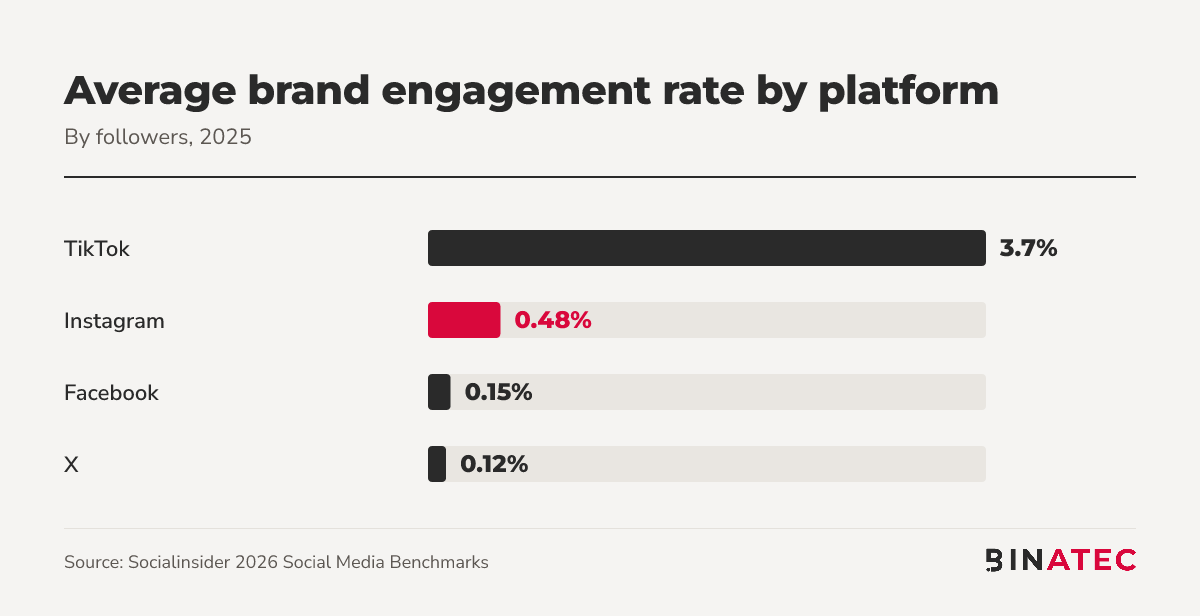
One warning before you compare. Socialinsider calculates Instagram engagement as likes plus comments divided by followers. Other tools divide by reach or impressions instead. ClickMinded's benchmark roundup notes that its sources use different samples and formulas and should not be compared directly unless the denominator matches.
So pick one formula, write it down, and judge yourself against your own last 90 days first.
Step 1: Track Sends, Not Just Likes
In a January 2025 video, Mosseri said that the top three ranking signals are watch time, likes and sends. He added that likes matter slightly more for content shown to people who already follow you, while sends matter slightly more for reaching people who don't.
That split is useful. Likes keep your current audience warm. Sends bring in new people.
In an earlier Q&A, he also said the rate matters more than the count, and that sends per reach correlate more with overall reach than anything else, in his experience. Instagram doesn't show sends per reach as a ready-made number, so check your post insights and work it out yourself: sends divided by reach.
A simple weekly routine:
- Open insights for your last 10 posts.
- Record average watch time, likes per reach and sends per reach in one sheet.
- Mark the top two posts on sends and write down what they had in common.
- Make more of that, and less of the posts nobody forwarded.

Step 2: Write for the Forward, Not the Like
People send a post when it makes them think of someone. A colleague with the same problem. A friend who'd laugh. A boss who needs convincing.
Social Media Today's summary of Mosseri's advice says to think about what would make someone want to show a post to others: something entertaining, emotional or unexpected.
For a business, that usually means one of these:
- A mistake your customers make, named so clearly they say "that's us".
- A checklist someone will forward to their team.
- A before and after that shows a real difference.
- A blunt opinion your competitors won't say out loud.
Ask yourself before posting: who would I send this to? If you can't name a person, rewrite it.
Step 3: Give Every Post a Hook and One Job
Watch time starts with the first line or the first slide. If it doesn't stop the scroll, nothing after it counts.
Hook formats that work
- A question about the reader's situation.
- A specific, sourced number.
- A claim that cuts against what most people believe.
Then give the post one job. One idea, one takeaway. If you try to teach five things, people remember none of them and send nothing.
Step 4: Use Carousels for Teaching
The same Social Media Today piece suggests carousels may suit the watch-time signal, because they take longer to view. That is the writer's reading, not an Instagram rule, so test it on your own account.
Where they clearly fit is anything with steps. A checklist, a framework or a list of mistakes gives people a reason to swipe, save and send.

Keep slides sparse: a short headline, one supporting line, plenty of space. If you want help turning your expertise into posts like this, our social media design team does exactly that.
Step 5: Post Less, Better
Socialinsider's data shows brands cut Facebook posting from 47 to 24 posts a month between 2024 and 2025, while the average engagement rate stayed at 0.15%. On X, brands raised output from 50 to 70 posts a month and the rate slipped from 0.15% to 0.12%.
That's correlation, not proof. But it says volume alone isn't buying engagement.
Try this for a month: cut your posting by a third and spend the saved time on the hook and design of the rest. Compare sends per reach before and after.
Step 6: Reply Fast and Start Conversations
Mosseri's overview of the top three signals doesn't mention comments. Comments still matter for the business, because they are where buyers ask questions and where you can show how you work.
End posts with a question that's easy to answer in a few words, then reply to every comment within a few hours. It builds trust even when it doesn't move a ranking.
Engagement Improvement in Action: A Quick Example
Say a regional accountancy posts five times a week and averages 0.3% on Instagram, mostly tips pasted as text over a stock photo.
Here is how the six steps would change that:
- Measure sends per reach on the last 10 posts and find that the only post with sends was a "5 invoice mistakes" list.
- Rewrite the plan around posts a business owner would forward to their bookkeeper.
- Open each post with a specific question or number.
- Turn the list-style ideas into carousels, one mistake per slide.
- Cut to three posts a week.
- Reply to every comment the same day.
This is an illustration, not a client result. The point is the sequence: measure, find what gets sent, make more of it.
When This Advice Doesn't Apply
Engagement is not revenue. A B2B company with 800 followers can have a modest rate and still win clients through a few well-placed posts.
If your goal is leads, track clicks, enquiries and booked calls too. Set that up in analytics so you can see which posts lead to real conversations, and use engagement as a leading signal rather than the goal. For a wider plan, see our social media marketing service.
FAQs
What is a good engagement rate on Instagram?
For brands, about 0.48% by followers is the 2025 average according to Socialinsider. Anything near or above 1% is strong on that formula. Always check how a benchmark divides, because reach-based rates run much higher.
Do shares matter more than likes?
Instagram's head says watch time, likes and sends are the top three signals. Sends matter slightly more for reaching new people, likes slightly more for existing followers. You need both, but sends are what grow your audience.
How often should I post on social media?
There's no universal number. Socialinsider found brands average about 20 posts a month on Instagram. Start with a pace you can keep at high quality, then test fewer, stronger posts against your current volume.
How do I calculate engagement rate?
The common formula is likes plus comments, divided by followers, times 100. Some tools divide by reach or impressions instead. Pick one, use it every time, and only compare against benchmarks using the same one.
Conclusion
The idea to remember: write for the person who forwards your post, not the person who taps a heart.
This week, pull sends per reach for your last 10 posts and make more of the top two. If you'd like a second pair of eyes on your social plan, you can get a free quote from our team.
Sources
- Socialinsider: 2026 Social Media Benchmarks
- ClickMinded: Social Media Benchmarks 2026
- Social Media Today: Instagram top ranking signals (Jan 2025)
- Social Media Today: Instagram chief on share rates (May 2024)


John Doe
Supreb Information. Thanks
15 July 2014 View replies . 1