



Want to rank higher in Google's local results? Here are 7 fixes in order of impact, based on Google's own rules and a 47-expert ranking factors survey.
You search for your own service in your own town, and your competitor is sitting in the map results while you're nowhere. Or worse, you're on page two of a list nobody scrolls.
Sound familiar?
Most advice on how to improve local SEO ranking is a long list of 40 tasks with no order. That's why owners burn a month on citations and never touch the one setting that decides whether they show up at all.
This guide puts the fixes in order of impact. It's built on what Google says about local ranking and on the 2026 Local Search Ranking Factors survey, where 47 local SEO experts scored 187 factors.
Key Takeaways
- Google says local results are mainly based on relevance, distance and prominence, and you can only change two of the three.
- In the 2026 expert survey, your primary Google Business Profile category scored highest of 187 factors for the local pack, at 227.
- Google can suspend a profile whose name includes taglines, service descriptions or location details, so keyword-stuffing the name is a risk, not a shortcut.
- Ratings and review volume both appear in the survey's top 10, but Google bans offering incentives for reviews.
- A dedicated page for each service ranked second among AI search visibility factors, so your website matters beyond the map.
How Does Google Rank Local Businesses?
Google is direct about it. Local results are mainly based on relevance, distance and popularity, which it describes as how well a profile matches the search, how far the business is from the searcher, and how well-known the business is.
Distance is mostly out of your hands. You can't move your shop closer to every customer. That leaves relevance and prominence, and that's where every fix below lives.
Google also says there is no way to request or pay for a better local ranking. Anyone selling you a guaranteed top spot is guessing.

What Actually Matters Most? The 2026 Expert Scores
Whitespark's survey, published on November 6, 2025, asks local SEO experts to score each factor. These are expert opinions, not Google's own weightings, but they're the best public read on priorities. The top of the local pack list looks like this.
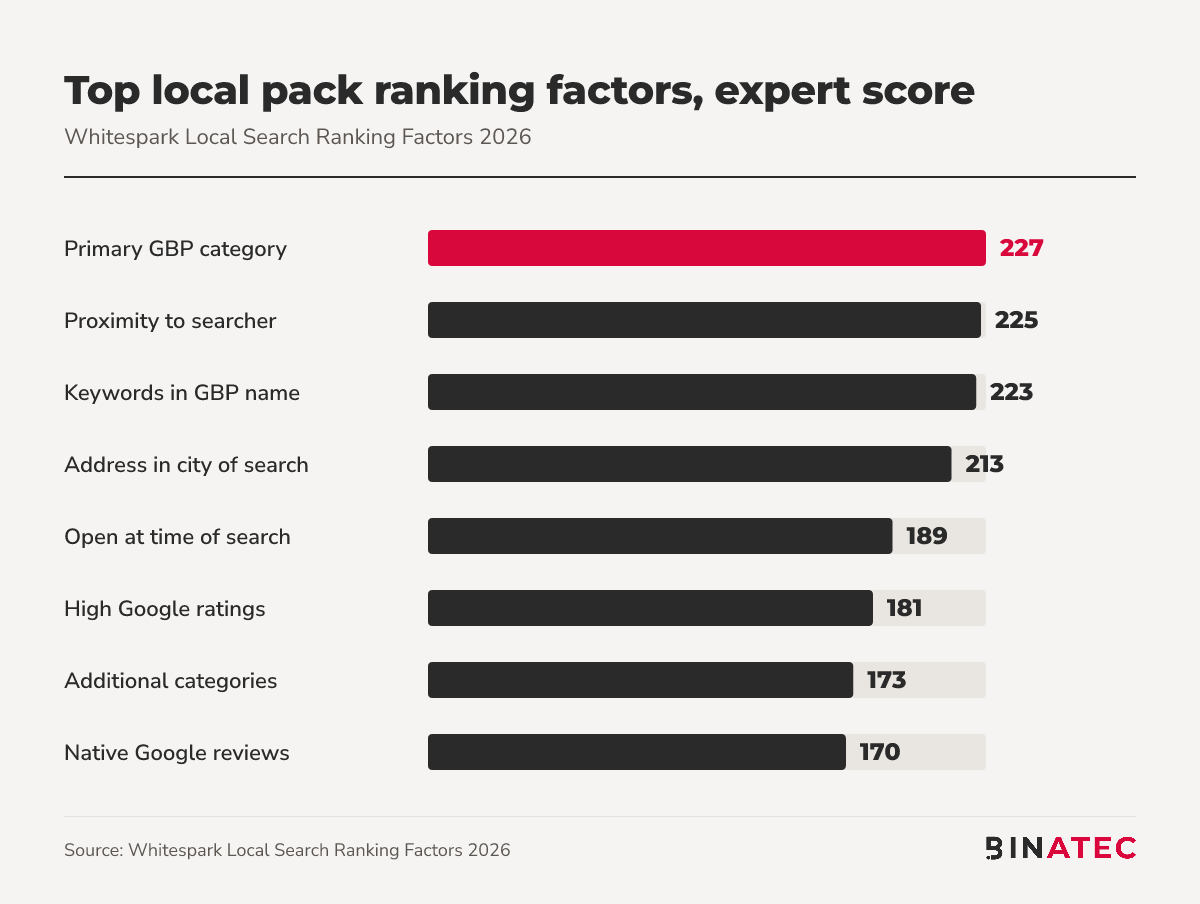
Notice what's not in the top ten: fancy tricks. It's your category, your address, your hours and your reviews. Boring, fixable, and mostly free.
Step 1: Verify and Complete Your Google Business Profile
Google says businesses with complete and accurate info are more likely to show up in local search results. It tells you to verify the business first, then keep your address, hours, category and attributes current.
Hours deserve a second look. In the survey, being open at the time of the search scored 189, which beats review count. Check your holiday and weekend hours today.
Step 2: Choose the Right Primary Category
This is the single highest-scoring factor in the survey, so don't pick it in a hurry. Choose the category that matches what customers search for, not the one that sounds most impressive.
A simple way to choose:
- List the three searches that bring you the most profitable customers.
- Look at which categories the businesses ranking for those searches use.
- Set your primary category to the closest match to your main revenue service.
- Add secondary categories only for services you really offer.
Additional categories scored 173 in the survey, so they do help, but they can't rescue a wrong primary one.
Step 3: Fix Your Business Name (Without Stuffing It)
Keywords in the profile name scored 223 in the survey. That's tempting. Don't do it.
Google's guidelines say your name should match what you use on your storefront and website, and that adding taglines, service descriptions or location details could result in the suspension of your Business Profile. If your real name already includes a keyword, fine. If it doesn't, leave it alone.
Step 4: Earn Reviews the Right Way
High Google ratings scored 181 and the quantity of native Google reviews with text scored 170. Reviews matter, and Google also counts them toward prominence.
The rules are clear in Google's review guidance. You can ask customers to leave a review by sharing a link or QR code. You can't offer free or discounted goods in exchange, and reviews must reflect a genuine experience.
Make it easy and routine:
- Send the review link by text or email within a day of finishing the job.
- Put a QR code on receipts, invoices or the counter.
- Reply to every review, short and specific, with no offers inside the reply.
Step 5: Build a Page for Each Service
Your website feeds relevance. In the survey's AI search visibility ranking, a dedicated page for each service scored 170, second only to appearing on expert-curated best-of lists at 179.
One 'Services' page listing everything is not enough. Give each main service its own page with the town or area you serve, what's included, prices or ranges where you can, and real photos. Our local SEO services and website design teams build exactly this structure.
Step 6: Get Mentioned Beyond Your Own Site
Google lists links from other websites as part of prominence. The survey backs it up for AI search too: three of the top five AI visibility factors are citation factors, including prominence on key industry domains (167) and authority of unstructured citations such as newspaper articles and industry associations (160).
In practice, that means local press, supplier and partner pages, chamber of commerce and industry association listings, and sponsorships with a real web page. A few relevant mentions beat fifty junk directories.
Step 7: Keep Photos, Posts and Details Fresh
Google recommends adding photos and videos so people can see what you offer. Treat it as a monthly job: new project photos, updated services, seasonal hours.
Local SEO in Action: A Quick Example
Picture a plumber in Leeds who's listed as 'Contractor', has hours set to 9 to 5 and offers 24-hour call-outs. Three small edits change the profile: primary category set to 'Plumber', 24-hour hours entered, and one page per service (boiler repair, leak detection, emergency call-out). That's an illustration, not a client result, but each edit maps to a factor in the top ten above.
When This Advice Won't Help
If you're a service-area business with no public address, the survey also lists whether your address shows on the profile (176), so you may face a ceiling in the map pack. Compete harder on reviews, service pages and mentions instead.
And if a competitor sits right next to the searcher, distance may beat all of your effort for that search. Aim at the searches where you're the closer or better-reviewed option.
FAQs
How long does it take to improve local SEO ranking?
Profile fixes like category, hours and name can be re-evaluated within days, but reviews, service pages and mentions build over months. Google publishes no timeline, so plan on steady monthly work and track map-pack position for your top three searches.
Can I pay Google to rank higher in the local pack?
No. Google states there's no way to request or pay for a better local ranking. You can run Local Services or Google Ads separately for paid placement, but organic map results come from relevance, distance and prominence.
Do I need a website to rank locally?
You can appear without one, but a website helps relevance and gives AI answers pages to cite. The survey ranks dedicated service pages second for AI search visibility, so a simple site with one page per service is worth building.
Can I give discounts for Google reviews?
No. Google's guidance says offering incentives such as free or discounted goods or services in exchange for reviews is prohibited. Ask every customer politely with a direct link or QR code, and never filter who you ask.
Conclusion
Start with the factors you fully control: category, hours, a clean name and a complete profile. Then build reviews, service pages and outside mentions month after month.
This week, open your profile and check the primary category and hours. It takes ten minutes and sits at the top of the expert list.
If you'd rather hand it over, get a free quote and we'll tell you where your local presence is leaking customers.
Sources
- Google Business Profile Help: Improve your local ranking
- Whitespark: Local Search Ranking Factors 2026
- Google Business Profile Help: Guidelines for representing your business
- Google Business Profile Help: Read and reply to reviews


John Doe
Supreb Information. Thanks
15 July 2014 View replies . 1