



OpenAI just named 20+ measurement partners and shared big early results for ChatGPT Ads. Here's what the numbers prove, what they don't, and how to test safely.
Have you been told you're missing out on ChatGPT Ads? Maybe a rep, a competitor or a LinkedIn post said the results are already beating paid search.
On 5 October, OpenAI published a list of measurement partners and a handful of early campaign results. PPC Land's write-up reports that ChatGPT now reaches 1.2 billion people weekly and passed a $1 billion annualised ad run rate at the end of August.
Big audience, big numbers, a tidy story. Sound familiar?
The problem is that almost none of those early results show how they were measured. This post separates what the announcement proves from what it only suggests, so you can decide whether to test, and how to test without burning budget.
Key Takeaways
- OpenAI named 22 unique measurement and verification firms on 5 October, so you can now plug ChatGPT Ads into tools you may already pay for.
- The headline results come from vendors, and the sources say they come without published spend, dates, sample sizes or benchmarks.
- Last-click and view-through reports measure credit, not cause, so a short conversion delay doesn't prove the ad created the sale.
- A geo-based lift test is the cleanest way to find out whether ChatGPT Ads produce sales you wouldn't have had anyway.
- Treat your first budget as a learning budget: set the attribution window, the success metric and the stop rule before you spend a dollar.
What OpenAI Actually Announced
The announcement is mostly about measurement plumbing. According to Relevant Audience, the partners fall into a few groups:
- Data connections: Hightouch, Tealium and LiveRamp, for sending conversion data from your own systems.
- Attribution: AppsFlyer, Triple Whale, Adjust, DV Rockerbox, Northbeam, Branch, Singular, Kochava, Airbridge and Tenjin.
- Full-funnel measurement: Fospha, Measured and INCRMNTAL.
- Geo-based incrementality tests (early stage): Haus, Measured and WorkMagic.
- Brand suitability pilots: DoubleVerify and Integral Ad Science.
OpenAI said 20 partners, but the lists add up to 22 unique names. That small mismatch tells you something: this is a fast-moving product, and the documentation is catching up.
The same announcement says advanced conversion optimisation now learns from eligible click-through and view-through conversions. PPC Land notes that the date this took effect and the billing basis aren't stated.

How Fast This Channel Grew
The scale is real. PPC Land reports OpenAI hit a $100 million annualised revenue rate on 26 March and $1 billion by 31 August.
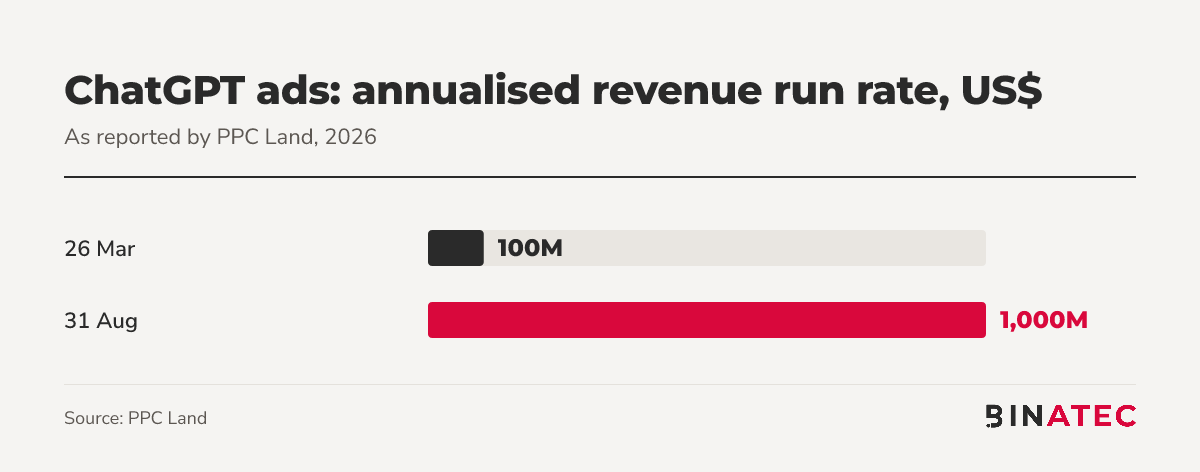
Money is moving there quickly. That's a reason to pay attention. It isn't a reason to believe every case study that comes with it.
The Early Results, One by One
Relevant Audience lists the partner-reported results. Here they are with the question each one leaves open:
- WeightWatchers: attributed CPA was 15.3% below its paid-search benchmark. Which benchmark, over which dates, at what spend?
- Dose: a geo-lift study estimated 2.3x more incremental orders than last-click captured, and 67% of incremental purchases came from new customers. Which regions, how long, and how confident is the estimate?
- Portland Leather Goods: 93% of visitors from ChatGPT Ads were new. New visitors aren't the same as new customers.
- Fospha: 83% more revenue per 1,000 impressions than the paid social average. Whose paid social average?
- Cross-vertical slide: 100% of campaigns delivered incremental conversions. How many campaigns, and who measured them?
Both sources are clear on the gap. The results are vendor-supplied, and the articles say spend, sample sizes and methods weren't published.
That doesn't make them false. It makes them unverified.
Credit Is Not Cause
One number in the announcement is easy to misread. OpenAI says 52.7% of eligible one-day view-through conversions happened within an hour of the matched impression.
It sounds like proof of influence. As Relevant Audience points out, it shows timing only, not causation. Plenty of people who see an ad were about to buy anyway.
This is the oldest trap in paid media. Attribution reports hand credit to whatever touched the customer last. Incrementality asks a different question: would this sale have happened without the ad?
OpenAI itself describes its incrementality work as still in its early stages, according to PPC Land. Take that at face value. If you want a proper read on which channels earn their budget, our channel attribution work starts from exactly this question.

How to Test ChatGPT Ads Without Fooling Yourself
You don't need a huge budget. You need a plan you'd be comfortable showing your finance lead.
Step 1: Set up clean signals
ChatGPT Ads supports a pixel and a Conversions API, and PPC Land says deduplication uses the pixel ID, event name and event ID. Make sure your events fire once, with the right values. The same coverage mentions an Event Quality Score in Ads Manager for judging signal quality. If your analytics setup is messy, fix that before you spend.
Step 2: Pick the attribution window up front
Advertisers can choose a click-through window and add a one-day view-through window for reporting, according to the same source. The settings don't change how campaigns optimise, so decide which view you'll judge success on and write it down.
Step 3: Run a holdout or geo test
Split regions into ads on and ads off, then compare total sales, not just ChatGPT-attributed sales. Haus, Measured and WorkMagic are named as geo-experiment partners, and you can also run a simple version yourself with your own sales data.
Step 4: Compare against total revenue
If ChatGPT reports 100 sales and your total sales didn't move, you've bought credit, not growth. Judge the test on your own revenue line.
Step 5: Decide the stop rule first
Set the budget, the test length and the cost per incremental sale you'll accept before launch. Then follow it. This is where a PPC management process earns its keep.
A Worked Example: Reading One Case Study
Take the Dose result. The geo-lift study estimated 2.3x more incremental orders than last-click attribution captured, per Relevant Audience.
That's an encouraging direction. It suggests last-click may undercount this channel. But the same coverage doesn't give the baseline, the test period or a confidence interval.
So what can you do with it? Use it as a hypothesis for your own test: "last-click may undercount ChatGPT Ads for us." Then run the geo test and find out. That's a far better use of a case study than copying its budget.
Where This Advice Breaks Down
A geo test isn't always possible. If you sell a few high-ticket services a month, regions won't give you enough volume to see a difference.
In that case, track downstream quality instead: qualified leads, booked calls and pipeline from ChatGPT-sourced traffic, checked against your CRM. It's a weaker test than a holdout, but it's honest about what it can show.
Availability matters too. The image-led ad format starts testing later in October in the US only, with an initial group of advertisers, per Relevant Audience. Partner availability by country isn't confirmed, so check with your vendor.
FAQs
Should my business advertise on ChatGPT now?
Only if you can afford to treat it as a test. The audience is large, but early results are vendor-reported and unverified. Start with a small, capped budget, clean conversion tracking and a pre-agreed way to judge success.
What is the difference between attribution and incrementality?
Attribution assigns credit for a sale to the ads a customer touched. Incrementality asks whether the sale would have happened without the ads. Attribution is easy to report. Incrementality needs a test, such as a holdout or geo experiment.
Which measurement partners work with ChatGPT Ads?
OpenAI named attribution partners such as AppsFlyer, Triple Whale, Northbeam and DV Rockerbox, plus Hightouch, Tealium and LiveRamp for data connections. Geo-test partners include Haus, Measured and WorkMagic. Availability can vary, so confirm with your vendor.
Does the attribution window change how my campaign optimises?
No. According to PPC Land's reading of OpenAI's post, the click-through and view-through window settings affect reporting, not how campaigns optimise. Choose the window you'll judge results on before launch so you don't pick the flattering one afterwards.
Conclusion
ChatGPT Ads are growing fast, and the measurement tools are catching up. The case studies are a reason to test, not a reason to trust.
This week, write down three things: what counts as a win, how long you'll run the test, and the cost per incremental sale you'll accept. Then check your conversion tracking fires once and correctly.
If you'd like a second pair of eyes on a test plan, get a free quote and we'll talk it through.
Sources
- PPC Land: OpenAI gains 20 measurement partners for ChatGPT Ads
- Relevant Audience: OpenAI names 20 ChatGPT Ads measurement partners and tests image-led ads


John Doe
Supreb Information. Thanks
15 July 2014 View replies . 1