



How to get cited by ChatGPT: let OpenAI's search bot in, match the questions it asks, and write pages it can quote. Seven steps, with data and a free test.
Have you typed your own service into ChatGPT and watched it recommend three competitors? Maybe it quoted a page you know is weaker than yours.
Sound familiar? You're not imagining it. ChatGPT only cites a fraction of the pages it reads, and the ones that win are rarely the ones you'd guess.
The good news is that the rules are less mysterious than the agency blogs make them sound. Some are documented by OpenAI itself, and others come from large studies of real prompts.
This guide gives you seven steps, in the order we'd do them, plus a free test you can run today.
Key Takeaways
- ChatGPT search can only cite your pages if you allow OpenAI's OAI-SearchBot crawler in robots.txt, and that is the first thing to check.
- Blocking GPTBot only opts you out of model training, so you can keep training blocked and still be eligible for ChatGPT search answers.
- Pages whose titles and URLs match the narrow follow-up questions ChatGPT asks tend to be cited more than pages that only match the broad topic.
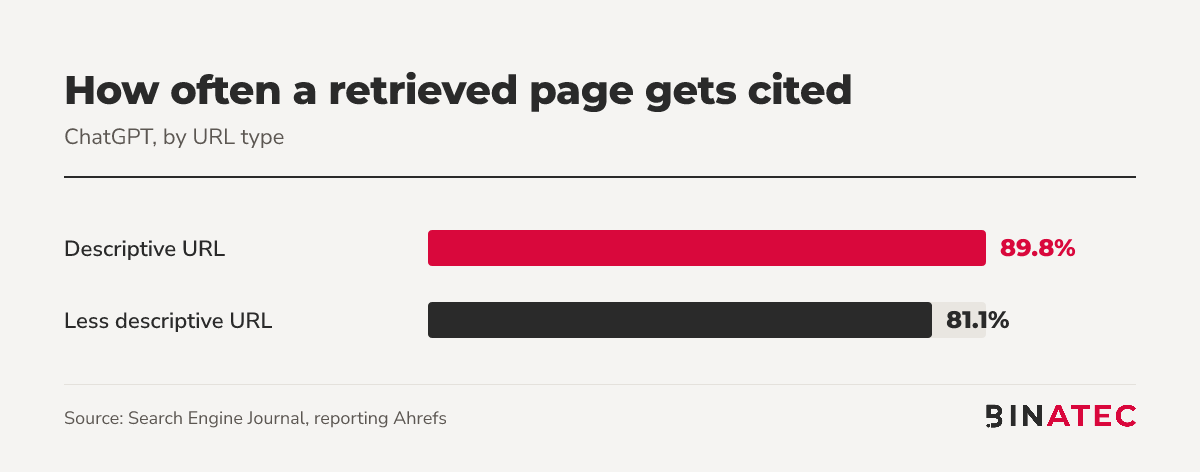
- Clear, descriptive URLs were cited 89.78% of the time they showed up in results, versus 81.11% for vague ones, in an Ahrefs study of 1.4 million prompts.
- Being retrieved is not the same as being cited, so a page needs a direct, quotable answer that the model can lift without rewriting.
- You can track the result: ChatGPT adds utm_source=chatgpt.com to referral links, so your analytics can show which pages earn the visits.
How to Get Cited by ChatGPT: The Short Version
To get cited by ChatGPT, let OpenAI's search crawler reach your site, publish a page that answers one specific question in its first lines, give it a title and URL that match that question, and back it with facts a reader can verify. Then check your analytics for ChatGPT referrals and improve the pages that don't get picked up.
Step 1: Let OpenAI's Search Bot In
This is the gate. According to OpenAI's crawler documentation, OAI-SearchBot is the crawler used for search, and sites that opt out won't appear in ChatGPT search answers.
OpenAI recommends allowing OAI-SearchBot in your robots.txt file. It also notes that changes can take about 24 hours to take effect.
Many sites block it by accident. A security plugin, a CDN rule or a blanket "block all AI bots" setting is usually the cause. If you suspect that's you, our guide on checking whether your site blocks ChatGPT Search walks through the test.

Step 2: Know Which Bot Does What
OpenAI runs three bots, and mixing them up is the most common mistake.
- OAI-SearchBot surfaces sites in ChatGPT's search features. Allow it if you want to be cited.
- GPTBot crawls content that may be used to train OpenAI's models. Disallowing it signals that your content shouldn't be used for training.
- ChatGPT-User fetches a page when a person asks ChatGPT about it. OpenAI says it isn't used to crawl the web automatically and doesn't decide whether content appears in Search.
That means you can block GPTBot to keep your content out of training and still allow OAI-SearchBot to stay eligible for citations. Those are two separate decisions, and your legal or brand team may want a say in the first one.
Step 3: Match the Questions ChatGPT Actually Asks
When you ask ChatGPT something broad, it doesn't search for your exact words. It breaks the question into narrower searches behind the scenes.
In a study of 1.4 million prompts, reported by Search Engine Journal, Ahrefs found that titles and URLs matching those narrower sub-queries correlated more strongly with citations than pages that only matched the original prompt broadly.
So a page called "Marketing Tips" loses to one called "How to Write a Product Description That Sells".

Here's a quick way to find them. Ask ChatGPT your customer's question, then list the follow-ups you'd naturally ask next: cost, timing, comparisons, mistakes. Each one is a candidate page.
Step 4: Use Clear, Descriptive URLs
It sounds too small to matter, but the same Ahrefs data, as summarised by Search Engine Journal, shows a gap. Pages with clear, descriptive slugs were cited 89.78% of the time they appeared in results, against 81.11% for less descriptive URLs.
Use plain words in the slug: /blog/how-much-does-seo-cost beats /blog/post-4821. Don't rename live URLs just for this, though. If you do change one, add a 301 redirect so you keep what you've earned.
Step 5: Put a Quotable Answer First
Retrieval and citation are different things. The same study found that Reddit pages from one source were retrieved but cited only 1.93% of the time, and Ahrefs said ChatGPT almost never gives that source the credit.
The lesson for your own pages: being read isn't enough. Make the answer easy to lift.
Use this layout on every page you want cited:
- A title that contains the question in its natural form.
- A 40-60 word answer right after the intro, written as a full sentence that stands alone.
- Headings phrased as the follow-up questions from Step 3.
- Numbers with the source named in the same sentence.
- A short FAQ with direct answers under each question.
We use this exact shape on our own articles, because it serves human skimmers too. Nobody has proven that any one format guarantees a citation, so treat it as good practice, not a hack.
Step 6: Back Claims With Sources You Can Link
Many guides tell you to add original data. That's good advice, but only if the data is real. Don't invent a statistic to look authoritative.
What works is being the page that states something precisely and shows where it came from. If you have first-party numbers (your own survey, your own customer questions, your own pricing ranges), publish them with the method. If you don't, cite the primary source and add your own interpretation.
Treat the precise "uplift" figures some vendors quote with caution. Most come from small samples or from tools the vendor sells.
Step 7: Measure and Repeat
OpenAI says ChatGPT adds the UTM parameter utm_source=chatgpt.com to referral URLs, which makes inbound traffic trackable, according to its publishers and developers FAQ.
In GA4, filter your traffic by that source. Some visits still land in Direct, so read how to find ChatGPT traffic hiding in GA4 before you trust the numbers.
Then run the test monthly: ask ChatGPT ten questions your customers ask, note which sources get cited, and see where you appear. Where you don't, check the page against Steps 3 to 5.
A Quick Example: Fixing One Page
Say you run a plumbing company with a page titled "Our Services" at /services-page-2. A homeowner asks ChatGPT, "How much does a boiler replacement cost?"
Today that page has no reason to be picked. A better version lives at /boiler-replacement-cost, has the title "How Much Does a Boiler Replacement Cost?", opens with a 50-word answer giving a price range and what changes it, then covers the follow-ups a buyer asks: timing, finance, warranty.
That page matches the question, the title, the URL and the answer. Nothing about it is clever, which is the point.
Where This Breaks Down
No one can promise you a citation. ChatGPT's results change, the studies above cover specific models and samples, and the SEJ report itself warns that patterns may not hold for newer models.
Authority still matters too. A brand-new site with one page won't outrank established publishers on competitive questions just by fixing a slug.
If you're early, aim at narrow, specific questions where few pages give a clear answer, and keep building the basics of SEO and technical SEO in parallel. Whether AI search is worth the effort at your size is a fair question, and our look at AI traffic versus Google covers it.
FAQs
Does blocking GPTBot stop ChatGPT from citing me?
No. OpenAI describes GPTBot as the crawler for training data and OAI-SearchBot as the one for search. You can disallow GPTBot and still allow OAI-SearchBot, which keeps your pages eligible for ChatGPT search answers.
How long does it take to get cited by ChatGPT?
OpenAI says robots.txt changes can take about 24 hours to take effect, but that only opens the door. Whether a page gets cited depends on the question, the page and the competition, so there's no fixed timeline. Check monthly instead of expecting a date.
Do I need to rank on Google to be cited by ChatGPT?
Not strictly, and the studies disagree on how strongly the two link. Good pages that answer specific questions tend to do well in both, so strong SEO fundamentals are a sensible base for AI visibility too.
How can I see whether ChatGPT sends me traffic?
Look for utm_source=chatgpt.com in your analytics. OpenAI says ChatGPT adds it to referral URLs from search results. Some visits may still appear as Direct, so treat the figure as a minimum, not the full total.
Is llms.txt needed to get cited?
We found no evidence in OpenAI's own documentation that an llms.txt file affects ChatGPT citations. Allowing OAI-SearchBot and publishing clear, specific pages matters far more, so do those first.
Conclusion
Getting cited comes down to being reachable, being specific and being easy to quote. None of it needs a trick.
This week, open your robots.txt and confirm OAI-SearchBot isn't blocked. Then pick your best page and rewrite its title, URL and opening answer to match one specific question.
If you'd like a hand, our GEO optimization and ChatGPT optimization services do exactly this, and you can get a free quote whenever you're ready.
Sources
- OpenAI: Overview of OpenAI crawlers
- Search Engine Journal: ChatGPT Often Retrieves But Rarely Cites Reddit Pages
- OpenAI Help Center: Publishers and Developers FAQ


John Doe
Supreb Information. Thanks
15 July 2014 View replies . 1