



Three new studies say ChatGPT sends a sliver of Google's traffic, but it converts 4.5x better. Here's how to size your AI search effort without wasting budget.
Have you spent the last year being told you must optimise for ChatGPT, or lose your customers to AI? Then this week's headlines will feel like whiplash.
Search Engine Roundtable ran a story on three new studies suggesting AI visibility may not be worth investing in. The numbers are small. Really small.
So should you drop your AI search work? Not quite. The data says something more useful than "ignore it" or "panic". Here's what it shows, where it's weak, and how to decide how much effort AI search deserves in your plan.
Key Takeaways
- In one 100-site GA4 analysis, ChatGPT sessions were just 0.62% of the volume Google organic sent over 12 months.
- The same analysis found ChatGPT visitors converting at 13.8% against 3.02% for Google organic, so the traffic is small but valuable.
- Google organic still drove 96.5% of conversions in that dataset, and 45 of the 100 sites weren't tracking any key events at all.
- A separate analysis of 12 sites found most of the apparent growth in Direct traffic was bots, and AI traces made up only 0.003% of Direct.
- All three studies have small samples, so use them to size your effort, not to write off AI search or to justify a big bet.
- The smart move is to measure AI referrals properly, fix the basics Google also rewards, and keep AI work to a modest, tracked slice of your plan.
What the Three Studies Actually Found
Let's take them one at a time, because they measure different things.
Study 1: ChatGPT Traffic Is a Rounding Error
Marie Haynes pulled 12 months of GA4 data from 100 websites, covering more than 145 million sessions. In her post "GEO is a distraction", she reports that ChatGPT sessions were 0.62% of the volume driven by Google organic. All large language models combined came to 0.73%.
That's the headline. The detail matters more.

Study 2: Organic Search Still Sends Far More
SEO Works published its own benchmark, covered in the same Roundtable story. It found organic search delivered 39 times more traffic than AI assistants. For every 100 conversions from organic search, AI referrals delivered 3.2.
It also found AI referral conversion was 0.67x that of paid search and 2.48x that of direct traffic. So AI visitors aren't magic. They convert better than direct visitors and a bit worse than paid.
Study 3: The AI Effect Hiding in Direct Traffic Is Mostly Bots
Many marketers suspect AI-driven visits are hiding in the Direct channel. Kevin Indig tested that in Growth Memo across 12 sites. Eight of the 12 showed Direct growth from August to September, but one site had 409,000 Direct sessions and only 198 engaged ones.
Across January to September, total Direct rose 140.9% while engaged Direct changed by -1.0%. Direct sessions with identifiable AI traces averaged 0.003% of all Direct traffic.
Indig is careful to say an effect could still exist. He just couldn't isolate one.
Small Traffic, Big Conversion Rate
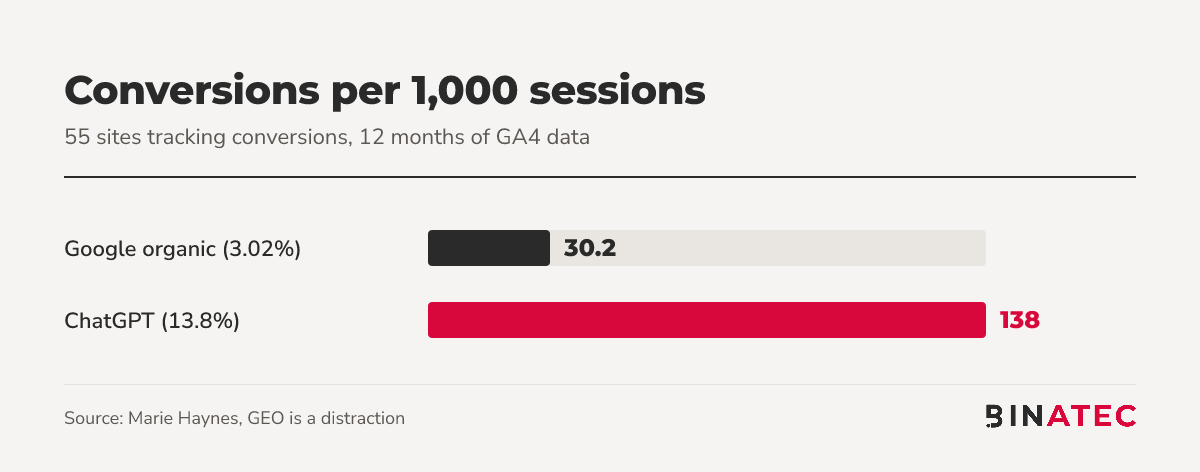
Here's the part the "GEO is a distraction" headline skips. In Haynes's data, the 55 sites that tracked conversions saw a 13.8% conversion rate from ChatGPT against 3.02% from Google organic. That's more than 4.5 times higher.
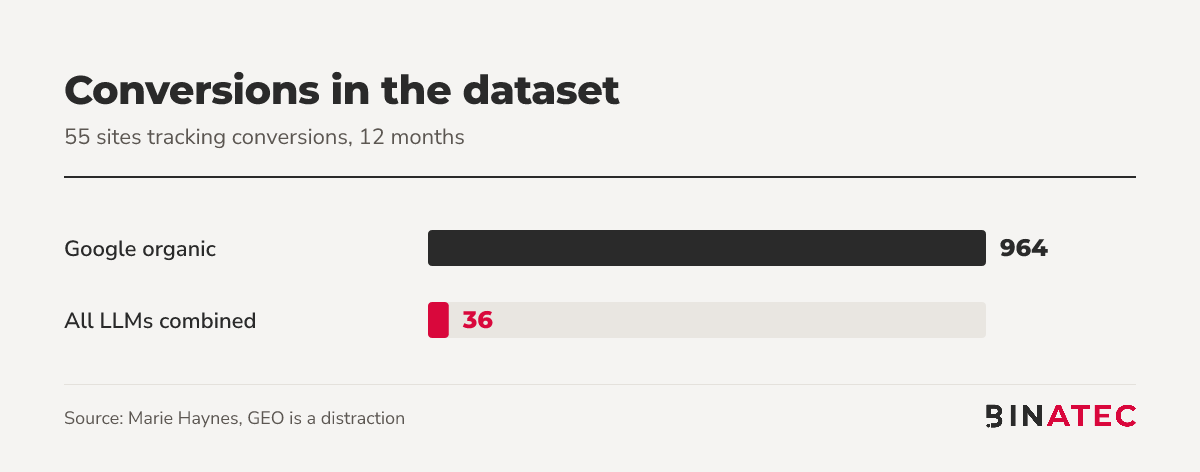
Then the volume reality hits. Haynes counted 964 conversions from Google organic against 36 from all LLMs combined. Google organic produced 27 times more.
Both facts are true at once. AI search visitors are high intent, and there aren't many of them yet.
AI Search Effort in Action: A Quick Example
Let's make it concrete with simple arithmetic on the figures above. This is an illustration, not a result from any Binatec client.
Say Google organic sends your site 10,000 sessions. At 0.62%, ChatGPT would send about 62. At 3.02%, Google's sessions produce roughly 302 conversions. At 13.8%, ChatGPT's 62 sessions produce roughly 9.
So the channel is worth about 3% of Google organic's conversions even with the better rate. That's not nothing. It's also not a reason to move half your content budget.
Why These Studies Shouldn't Settle the Debate
Before you quote these numbers in a board meeting, look at the limits. Each author flags some of them.
Keep these caveats in mind:
- Haynes calls her dataset small, and her conversion comparison rests on only 55 sites.
- Indig's sample is 12 sites, skewed toward B2B and the US, and he ran hundreds of tests, which raises the chance of false positives.
- The Roundtable write-up gives no detail on how each study defined AI traffic or conversions.
- Referral data only counts clicks. AI answers can shape a buyer's shortlist without sending a visit, and no click-based study captures that.
That last point is the real gap. If a buyer asks an AI tool for options, sees your name, then searches for you later, analytics credits Google or Direct. The studies can't see it. Indig says as much: put visibility, customer behaviour and business outcomes in the same monthly report.
What to Do This Quarter
A practical order of work:
- Define a conversion and track it. Haynes found 45 of her 100 sites tracked no key events. If that's you, set up web analytics before any AI search spend.
- Split AI referrals out in GA4. Create a channel group for chatgpt.com, perplexity.ai, gemini.google.com, copilot.microsoft.com and similar sources, and watch sessions and conversions monthly.
- Clean your Direct traffic. Indig suggests breaking Direct down by day, landing page, country, browser, OS and screen size, and looking for spikes with low engagement.
- Ask new leads how they found you. Add a "how did you hear about us?" field and include AI tools as an option. It catches what clicks miss.
- Keep the SEO foundation strong. Google still drove 96.5% of conversions in Haynes's data. Solid SEO and technical SEO also help the pages AI tools read.
- Give AI search a small, tracked slice. A modest GEO and AI search workstream is reasonable. A rebuilt strategy around it isn't, on this evidence.

Why Your Own Data Beats Any Average
A study of 100 sites tells you about those 100 sites. Your business may sit well above or below that average, and the gap can be large.
A local service firm with few comparison searches might see almost no AI referrals. A software company whose buyers ask AI tools for vendor lists might see far more. Neither result is wrong.
That's why the first step is measurement, not strategy. Two months of clean AI referral data and a "how did you hear about us?" field will tell you more about your market than any benchmark, including these ones.
When AI Search Deserves More Than a Small Slice
The advice above fits most businesses. It breaks down in a few cases.
If your own GA4 shows AI referrals already converting well, scale up what works. If you sell something buyers research heavily before contacting anyone, such as B2B software or professional services, shortlist influence matters more than click counts. And if Indig's third signal, customer answers on how they found you, keeps naming AI tools, believe your customers over an industry average.
On the other side, if you have no tracking and no SEO basics, AI visibility work is premature.
FAQs
Is GEO a waste of money?
Not on this evidence, but it shouldn't be your biggest line item. In Haynes's data, LLMs drove 36 conversions against 964 from Google organic. Treat it as a small, measured addition to solid SEO, and scale it only if your own numbers support it.
How do I track ChatGPT traffic in GA4?
Build a custom channel group or a report filter on session source, matching domains like chatgpt.com and perplexity.ai. Then compare sessions and conversions against Google organic each month. Some AI visits arrive without a referrer, so also ask new customers how they found you.
Does AI traffic convert better than organic search?
It depends on the dataset. Haynes saw 13.8% for ChatGPT against 3.02% for Google organic. SEO Works found AI referral conversion 0.67x paid search and 2.48x direct traffic. Both samples are modest, so check your own conversion data.
Is AI traffic hiding in my Direct channel?
Probably less than you think. Indig found most Direct growth in his 12 sites came from bots, and identifiable AI traces were 0.003% of Direct. Filter bots first, then judge.
Conclusion
The idea to remember: AI search is a small channel with good-quality visitors, and Google is still where most of your conversions come from. Size your effort to match.
This week, check whether your analytics even records a conversion, then split out AI referrals and clean your Direct traffic. Ten minutes of GA4 beats a hundred hot takes.
If you want help sizing where AI search fits in your wider growth plan, we're glad to look at your numbers. You can get a free quote any time.
Sources
- Search Engine Roundtable: 3 New Studies Suggest AI Visibility & Search Not Worth Investing In
- Marie Haynes: GEO is a distraction
- Kevin Indig, Growth Memo: Does AI drive more direct traffic?


John Doe
Supreb Information. Thanks
15 July 2014 View replies . 1