



Need a go-to-market strategy that sales and marketing both follow? Here are 6 practical steps, plus 2026 survey data on why most plans stall.
You've built something good. Maybe it's a new product, a new service line, or a push into a new market. Now comes the question that stalls more launches than any technical problem: how do we actually get this in front of the right buyers?
Most teams answer with a list of activities. A few ads, a blog, some outbound emails, a webinar. Sound familiar?
That list isn't a go-to-market strategy. It's a to-do list, and it breaks the moment sales and marketing disagree about who the customer is.
This guide walks you through six steps to build a go-to-market (GTM) strategy you can start using this quarter, with the 2026 data that shows where most plans go wrong.
Key Takeaways
- A GTM strategy is a shared plan for who you sell to, why they should choose you and how they'll find you, not a list of marketing activities.
- According to MediaPost's report on an Outcomes Rocket survey, only 37% of B2B professionals clearly see GTM as a cross-functional framework.
- 6sense found that buyers pick the winning vendor from their Day One shortlist 95% of the time, so being known early matters.
- Start with a narrow ideal customer profile, then build positioning, channels, a sales handoff and a measurement plan around it.
- Review the plan every quarter, because buyer behaviour, channels and competitors keep moving.
What Is a Go-to-Market Strategy?
A go-to-market strategy is the plan for how you reach your target customers, win their business and grow revenue from a product or service. It covers who you sell to, what you promise, which channels you use, how sales takes over and how you measure results.
It's not the same as a marketing plan. A marketing plan covers campaigns. A GTM strategy covers the whole path from a stranger noticing you to a customer renewing.
Here's the problem most businesses run into. The Outcomes Rocket survey of 511 B2B professionals in the US and UK, reported by MediaPost, found that only 37% showed a clear understanding of GTM as an integrated, cross-functional framework rather than a collection of marketing and sales activities. It also found that 21% either lack a GTM strategy or have no clearly defined ownership structure.

Why Most GTM Plans Stall
The same survey asked what gets in the way. The answers read like a checklist of what the six steps below are designed to fix.
Competition and market saturation (43.1%) and lead generation or pipeline quality (42.5%) topped the list, according to the MediaPost write-up. Sales-marketing alignment (28.7%) and measuring GTM ROI and attribution (23.5%) were also named by a meaningful share of respondents.
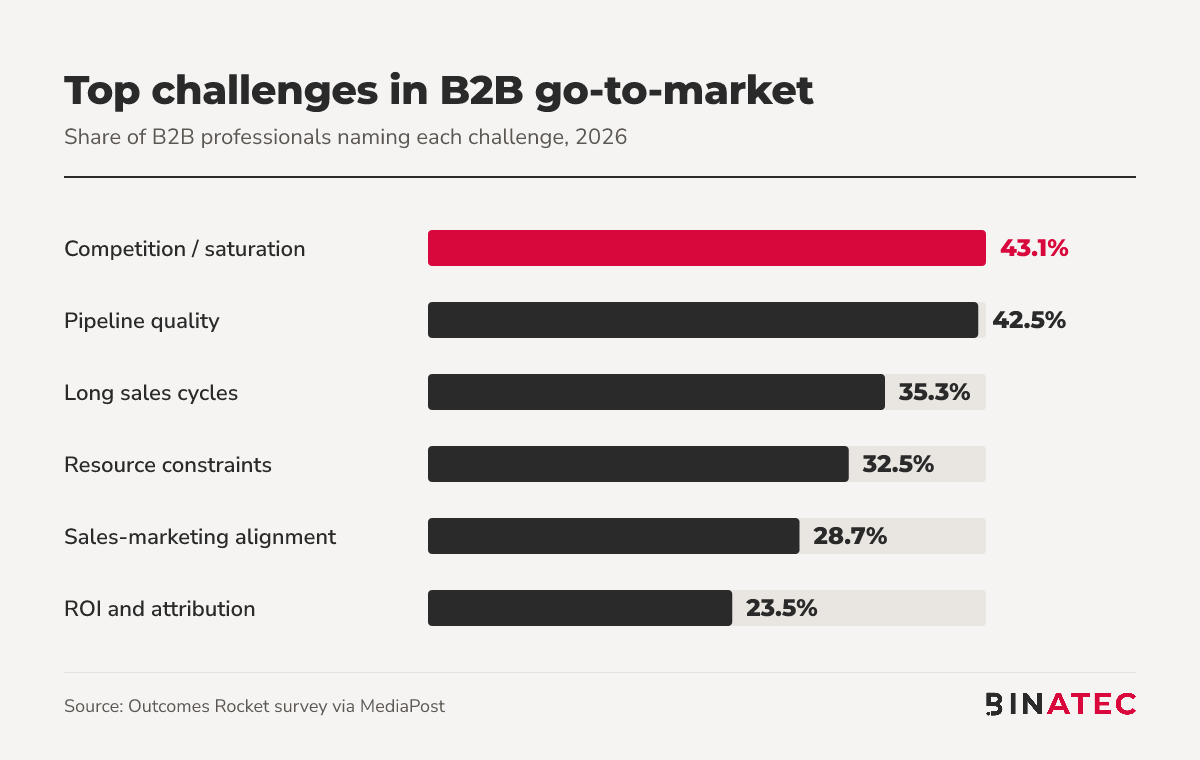
Notice what's missing from the top of that list: not a single one is about a lack of tactics. The trouble is focus, fit and follow-through.
Why Being Known Early Matters More Now
There's a second reason to get this right. 6sense's 2025 B2B Buyer Experience Report found buyers choose from one of the vendors on their Day One shortlist 95% of the time, up from 85% the year before. The vendor a buyer ranks first before any contact with a seller wins roughly 80% of the time.
The same report says buyers initiated 79% of first engagements. So by the time someone fills in your form, much of the decision has already been made.
One caution: 6sense sells intent data and ABM software, so treat the numbers as one vendor's study. The direction is still useful. If buyers form a shortlist before they talk to you, your GTM plan has to earn a place on it.
How to Build Your GTM Strategy in 6 Steps
Step 1: Define a Narrow Ideal Customer Profile
Start with who you sell to, and be specific. Pick an industry, a company size and a role that you can describe in one sentence.
Use your best existing customers as the pattern. Which ones buy fastest, stay longest and refer others? Write down what they have in common. If you have no customers yet, interview ten people in your target market before you spend on anything else.
Broad targeting feels safe and wastes money. A tight profile makes every later step cheaper. Our guide on how to define your ideal customer profile goes deeper.
Step 2: Learn What Your Buyers Care About and Who You're Up Against
Find out what your buyers are trying to fix, what they've tried and why they switch. Calls with customers and lost deals tell you more than any report.
Then look at your competitors the way a buyer would: their pricing page, their messaging, their reviews. Since competition is the top challenge in the survey above, you need a clear answer to "why you instead of them?" Our competitor analysis service is built for exactly this step.
Step 3: Write Positioning and Messaging You Can Say in One Breath
Turn what you learned into one clear statement: who it's for, the problem it solves, how you're different and the proof.
A simple test for your positioning:
- Can a stranger repeat what you do after reading your homepage for ten seconds?
- Does it name the customer's problem, not your feature list?
- Could a competitor copy the same sentence word for word? If so, rewrite it.
- Do sales and marketing use the same wording?
Step 4: Pick a Few Channels and Match Them to Your Buyers
Resist the urge to be everywhere. Choose two or three channels where your ideal customers already look for answers.
The Outcomes Rocket data gives a sense of what B2B teams find effective: in-person events (44%), customer marketing and referrals (35.1%), email and marketing automation (34.7%) and organic content and SEO (31%). Your mix will differ, but notice how many are about trust, not just clicks.
Because buyers shortlist early, plan for being found in search and AI answers as well as in ads. SEO, Google Ads and LinkedIn Ads each play a different part, so decide the job each channel does before you buy a single click.

Step 5: Design the Handoff From Marketing to Sales
A lead that sits for three days is a lead you paid for and lost. Agree on what counts as a qualified lead, who follows up, how fast and what happens if nobody does.
Put it in writing. Then connect the tools so nothing is retyped: your forms, CRM and marketing automation should show the same story. Sales-marketing alignment was a named challenge for 28.7% of respondents, so this step is where many plans quietly fail.
Step 6: Set Metrics, Owners and a Review Rhythm
Decide in advance what success looks like, with a small set of numbers: pipeline created, conversion between stages, sales cycle length and cost to win a customer.
Give the plan one owner. The survey found ownership of GTM is split between sales (33.9%), marketing (24.9%), product (15.3%) and others, which is how things fall between chairs. Then review the numbers monthly and revisit the whole plan every quarter. Channel attribution helps you see which channels are really producing pipeline.
A GTM Plan in Action: A Quick Example
Here's a worked example, built as an illustration rather than a client story. Imagine a ten-person software company selling scheduling tools.
- ICP: dental and physio clinics with 3-10 practitioners, where the practice manager chooses the tools.
- Positioning: fewer no-shows without more admin work.
- Channels: local search content, Google Ads on high-intent queries and referrals from existing clinics.
- Handoff: demo requests get a call within one business hour, owned by one named person.
- Metrics: demos booked, demo-to-trial rate, trial-to-paid rate and cost per paying clinic.
Every line fits on one page, and every team member can see their part of it. That's the test of a workable plan.
Where This Approach Breaks Down
A six-step plan isn't right for every situation. If you're pre-product and still discovering who wants what you're building, spend your time on customer interviews and small experiments before you write a full strategy.
It also won't fix a weak product. Positioning can make a good offer clearer, but it can't make a poor one sell. And if your buyers are mostly consumers, some details change: sales handoff matters less and brand, creative and conversion rate matter more.
FAQs
What are the main parts of a go-to-market strategy?
A GTM strategy has six parts: your target customer, what you learned about buyers and competitors, positioning and messaging, the channels you'll use, the handoff from marketing to sales, and the metrics you'll track. Pricing and the sales model sit inside these, depending on your business.
How long does it take to build a GTM strategy?
A first version can take two to four weeks if you already have customers to learn from. The research and positioning take the longest. Treat it as a living document, and plan to revise it each quarter as results come in.
Who should own the go-to-market strategy?
One named person should own it, usually a founder, a head of growth or a revenue leader. Sales, marketing and product all contribute, but shared ownership often means nobody is accountable. The survey above shows ownership is split across several functions.
What is the difference between a GTM strategy and a marketing plan?
A marketing plan covers campaigns and content. A GTM strategy is wider: it includes who you target, how you position against competitors, how sales takes over and how you measure revenue. A marketing plan is usually one part of it.
Conclusion
The idea to remember: a go-to-market strategy is a decision about focus, not a list of tactics. Pick a narrow customer, say something clear, choose a few channels and make the handoff work.
This week, write your ideal customer in one sentence and ask sales and marketing to check it. If they give you different answers, you've found your first job.
If you'd like a second pair of eyes on your plan, our go-to-market strategy service is built for this, or you can get a free quote and tell us where you're stuck.
Sources
- MediaPost: Go-to-market fills the basket (Outcomes Rocket 2026 State of B2B GTM)
- 6sense 2025 B2B Buyer Experience Report


John Doe
Supreb Information. Thanks
15 July 2014 View replies . 1