



Google's November 2026 core update started Nov 10 and may run until Nov 24, right before Black Friday. Here is what to check, what to leave alone, and when.
Did your rankings wobble this week? Maybe a page that always sat in the top three slipped, or your organic sales look softer than last Monday.
There is a good chance it's not you. Google started its November 2026 core update on November 10, and it applies globally and to all languages.
The awkward part is the timing. Google says the rollout may take up to two weeks, which runs right into the Black Friday and Cyber Monday run-up. So you're being asked to make decisions while the data is still moving.
This post tells you what Google has actually said, what the numbers from past updates suggest, and the short list of things worth doing this week (plus the one thing to avoid).
Key Takeaways
- Google began the November 2026 core update on November 10, and its notice says the rollout may take up to 2 weeks, so it could run until November 24.
- Google's own guidance is to wait at least a full week after the update finishes before judging your Search Console data.
- Past core updates in this period took between about 12 and 18 days, so plan for the volatility to last into the week of Thanksgiving.
- Small ranking drops are normal, and Google warns against drastic changes to content that already performs well.
- Record your baseline now: the week before November 10 is the comparison window Google suggests for pinpointing what changed.
- Third-party rank trackers can be noisy during an update, so lean on Search Console clicks and your own sales numbers.
What Google Has Said About the November 2026 Core Update
Google logged the update on its Search Status Dashboard with a start date of November 10, 2026. The dashboard entry doesn't give an end date yet.
According to PPC Land's report, Google's notice says the rollout "may take up to 2 weeks to complete" and names no ranking system, content type, query category or market.
In plain terms: nobody outside Google knows yet who wins and who loses. Anyone claiming to is guessing from early data.
It's also the third core update of 2026, following the March and May releases. Google describes these as broad changes that "don't target specific sites or individual web pages".

How Long Will This Update Take?
Google's two-week window is a maximum, not a promise. Recent updates show a range.
PPC Land lists the December 2025 update at 18 days, March 2026 at 12 days and 4 hours, and May 2026 at 11 days and 21 hours. The chart below puts them side by side.
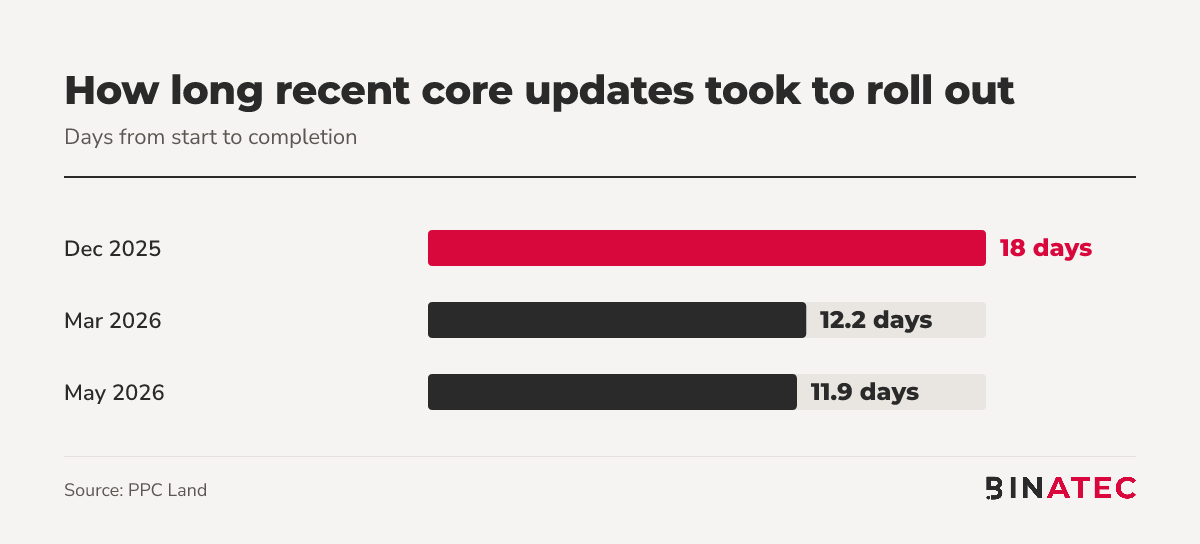
If this one lands in the middle of that range, it finishes around November 22 to 28. If it hits the 14-day maximum, it ends November 24. Either way, expect movement through Thanksgiving week.
Why the Timing Hurts Ecommerce and Seasonal Sellers
Thanksgiving is November 26, Black Friday is November 27 and Cyber Monday is November 30. Google's advice is to wait a full week after the update completes. If it finishes on November 24, that week ends December 1, after Cyber Monday.
That means you won't get a clean read before the biggest sales days of the year. So don't plan your promotions around a ranking forecast. Plan around the traffic you can control: email, paid media and your existing customers.
What to Do This Week
Here is a short, calm checklist:
- Note the dates. Write down November 10 as the start, then record the end date when the dashboard shows it.
- Save your baseline. Export Search Console clicks, impressions and average position for your top 20 pages for the week before November 10.
- Check money pages first. Look at the pages that drive leads or sales, not the whole site. A drop on a blog post matters less than a drop on a product or service page.
- Split by search type. Google suggests breaking results down by Web, Images, Video and News so you can see exactly where a change happened.
- Cross-check with real sales. Compare organic revenue or enquiries, not just rankings. Rankings can move without any change in orders.

A Quick Example: Reading a Drop Without Panicking
Say your category page for a product slipped from position 3 to position 5 on November 12. Your clicks are down a little.
Following Google's guidance, you don't edit it today. You note the drop, wait for the rollout to finish, wait a further week, then compare that week with the week before November 10. If the page is still down, you review it for real quality gaps: thin answers, outdated details, weak evidence.
If it has bounced back, you've saved yourself a rewrite that could have made things worse. Google's documentation says there is "no need to take drastic action" for small drops and warns against changing content that already performs well.
Be Careful With Early Volatility Data
Rank trackers tend to light up during updates, and some of that is noise. PPC Land cites DemandSphere reporting spurious results on about 11% of its daily rank checks and Nozzle counting 8.0% of results pages as poisoned.
Neither vendor fully disclosed its method, and Google hasn't commented on either figure, so treat them as warning signs, not facts. We covered the same problem in Is Your Rank Tracker Lying?.
The practical point: if a tracker says you lost ten positions overnight, confirm it in Search Console before you react.
When a Drop Is a Real Problem
Some drops are not noise. A large, sustained fall across your whole site after the update has finished deserves a proper review.
Google's guidance points to its helpful content self-assessment and suggests asking unaffiliated people to review your site. It also says to avoid quick fixes and treat deleting content as a last resort.
And be patient about recovery. Google says improvements can show within days, but that it could take several months for its systems to learn and confirm a site's quality. If nothing changes after a few months, the next core update may be when it registers.
This is also where the nuance sits: if your traffic is flat or up, do nothing different. A core update isn't a prompt to rewrite pages that are working.
FAQs
When did the Google November 2026 core update start?
It started on November 10, 2026, according to Google's Search Status Dashboard. Google says it applies globally and to all languages, and that the rollout may take up to two weeks to complete, which means it could run until November 24.
Should I change my website during a core update?
Usually not. Google says there's no need for drastic action on small drops and advises against changing content that already performs well. Record your numbers, wait for the rollout to finish, then wait a full week before you analyse your data.
How long should I wait before checking Search Console?
Google recommends waiting at least a full week after the update completes. Then compare the current week with the week before the rollout began. That comparison helps you see which pages and queries changed.
Can I recover rankings lost in a core update?
Sometimes, but it isn't guaranteed. Google says improvements can show within days, though it may take several months for its systems to confirm a site's quality. If nothing changes, a later core update may reflect your improvements.
Conclusion
The one idea to remember: a core update is a measurement problem before it's a content problem. Capture your baseline, wait for the rollout to end, then judge your data a week later.
Your first action this week is simple. Export your Search Console numbers for the week before November 10 and save them somewhere safe.
If you'd like a second pair of eyes on a drop, our SEO services and SEO reporting work is built for exactly this. You can also get a free quote and we'll tell you honestly whether it's the update or something else.
Sources
- PPC Land: Google's core update shifts rankings for up to 2 weeks before Black Friday
- Google Search Central: Core updates
- Google Search Status Dashboard


John Doe
Supreb Information. Thanks
15 July 2014 View replies . 1