



LinkedIn Ads vs Facebook Ads: see 2025 cost per click and cost per lead data, and a simple rule for which platform to fund first for your business.
You have a few thousand pounds or dollars a month to spend on paid social. Everyone tells you something different. LinkedIn is "where the decision-makers are". Facebook is "where the cheap clicks are". Both sound right, and only one of them is going to fill your pipeline.
Sound familiar?
The honest problem is that most comparisons stop at cost per click. A click isn't a customer. The real question is which platform gives you a qualified lead at a price your sales numbers can carry.
This guide puts real 2025 benchmark numbers side by side, shows where each platform wins, and ends with a simple rule for choosing.
The short answer: LinkedIn Ads cost far more per click and per lead, but let you target by job, company and industry, so they suit B2B offers with a high deal value. Facebook Ads (Meta) are cheaper and better for broad audiences, retargeting and offers that sell to consumers or small businesses. Pick by deal value, not by clicks.
Key Takeaways
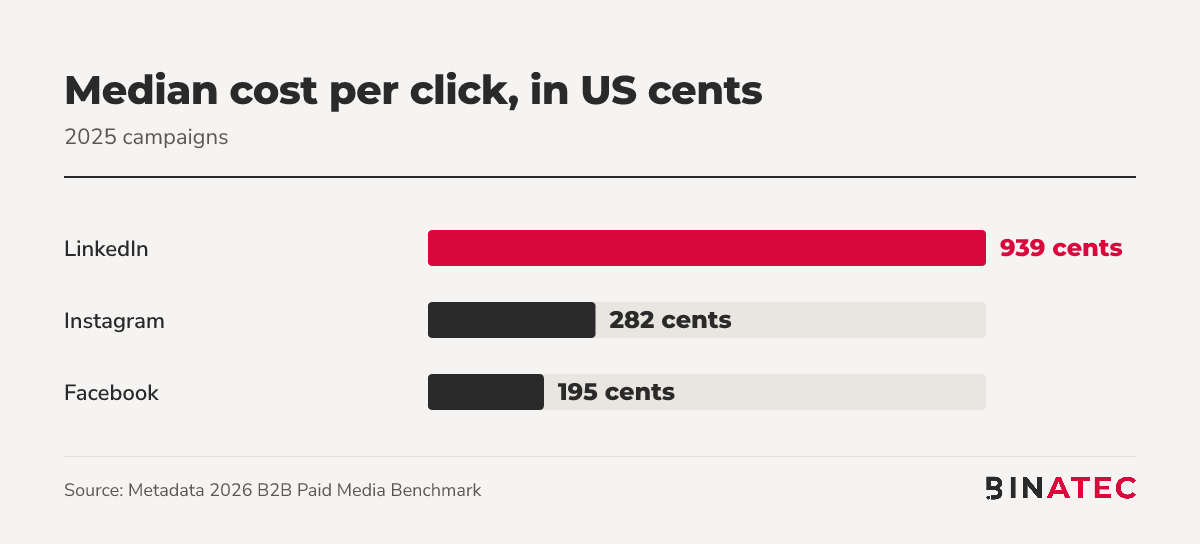
- In Metadata's 2025 data, LinkedIn's median cost per click was $9.39 against $1.95 on Facebook, about 4.8 times higher.
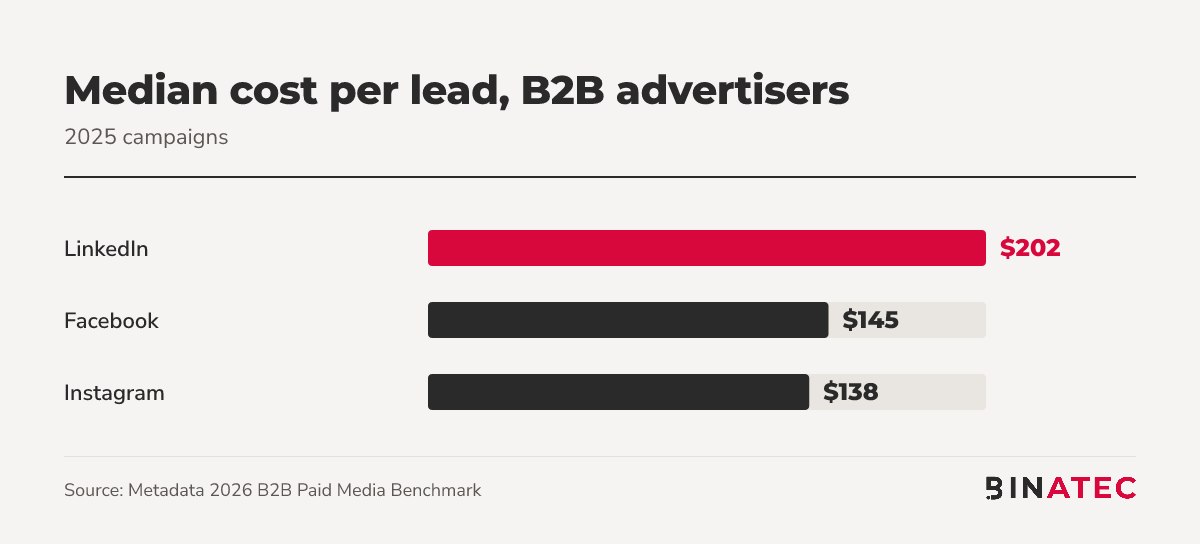
- The gap shrinks at the lead stage: median cost per lead was $202 on LinkedIn and $145 on Facebook, a difference of about 39%.
- LinkedIn's edge is targeting by job, company and industry, not cheaper traffic, so it pays off when one customer is worth thousands.
- A lead isn't a sale: LinkedIn's median cost per customer in the same report was $58,572, so judge both platforms on pipeline, not form fills.
- Facebook usually wins on cost, volume and retargeting, which makes it the better first test for low-ticket and consumer offers.
- You don't have to choose forever: start on one platform, track cost per qualified lead, and add the second once the first one works.
What Is the Real Difference Between LinkedIn Ads and Facebook Ads?
They sell different things. LinkedIn sells access to people by their professional identity. Facebook, through Meta's ad system, sells access to huge audiences, then uses its delivery system to find the people most likely to act.
On LinkedIn you choose the audience: job titles, seniority, industries, company size. On Facebook you describe the audience loosely and let the system find buyers inside it. That one difference explains most of the cost gap.
It also explains the sizes you need. LinkedIn's help centre says an ad set needs at least 300 member accounts, but suggests a minimum of 50,000 to drive results. Narrow targeting is the whole point of the platform, and it's also what makes each click expensive.

How Much Do LinkedIn Ads and Facebook Ads Cost?
Prices vary wildly by industry, so use benchmarks as a range, not a promise. The cleanest recent comparison comes from the Metadata 2026 B2B Paid Media Benchmark, which covers 153 B2B advertisers and $57.6M of 2025 ad spend. Its figures are medians across advertisers.
Start with clicks. LinkedIn's median CPC was $9.39. Facebook's was $1.95.
Now leads. In the same report, the median cost per lead was $202 on LinkedIn, $145 on Facebook and $138 on Instagram. The lead gap is much smaller than the click gap, because LinkedIn's lead forms and audience quality convert clicks into leads more efficiently.
Click-through rate tells the same story from another angle. Metadata found a 0.67% CTR on LinkedIn and 0.79% on Facebook, so Facebook ads weren't just cheaper, they were clicked slightly more often.
What Budget Do You Need to Start?
LinkedIn is open to small budgets on paper. LinkedIn says the minimum daily budget is $10 for any ad format, and the minimum lifetime budget for a new campaign is $100.
In practice, that won't teach you much. At a $9.39 median click, $10 a day buys about one click. You need enough spend to collect a meaningful number of leads before you judge the channel.
A rough way to size a test: take the median cost per lead for the platform, multiply by the number of leads you need to judge it (say 20), and budget that over four to six weeks. On LinkedIn that's roughly $4,000. On Facebook it's closer to $2,900. Those are planning figures built from the medians above, not guarantees.
When Do LinkedIn Ads Win?
LinkedIn is worth the premium when three things are true: your buyers are identifiable by job or company, each customer is worth a lot, and your sales cycle has room for a sales team to follow up.
Typical fits:
- Enterprise or mid-market software, where one customer is worth tens of thousands.
- Professional services, such as consulting, legal, finance and recruitment, aimed at named roles.
- Account-based campaigns where you already have a target list of companies. Our account-based marketing work usually starts here.
- Events and webinars for a specific job function.
There's evidence of pipeline payoff too. Metadata's benchmark reports that LinkedIn sourced 10.2 times pipeline per lead-generation dollar, with a 19.5% close rate, among CRM-connected advertisers. That's a sample of advertisers who track deals carefully, so treat it as an upper bound for what's possible, not an average you'll get.
It's also the same report that puts LinkedIn's median cost per customer at $58,572 across 94 CRM-connected advertisers. High cost, high deal values. That's the trade.

When Do Facebook Ads Win?
Facebook wins whenever volume, price or retargeting matter more than precise job-title targeting.
Typical fits:
- Ecommerce and consumer products, where the buyer is a person, not a job title.
- Local and small-business services, where the owner is on Facebook anyway.
- Retargeting website visitors and past customers at a fraction of LinkedIn's CPC.
- Low-ticket offers, such as courses, tools and subscriptions, where a $145 lead is too expensive but a $15 sale isn't.
B2B isn't off the table. Plenty of owners of small firms spend more time on Facebook and Instagram than LinkedIn. If your buyer is a business owner rather than a department head, test Meta first. Our Meta Ads service is built for that kind of test.
LinkedIn Ads vs Facebook Ads in Action: A Quick Example
Take a software company that sells a $20,000 annual contract. Using the benchmark medians above, 20 leads cost about $4,040 on LinkedIn and $2,900 on Facebook.
On paper Facebook is cheaper. But if only the LinkedIn leads are the right job title and company size, the cheaper leads may never become meetings. If one in five LinkedIn leads becomes a meeting and one in twenty Facebook leads does, the cost per meeting flips.
Those conversion rates are an illustration, not data. That's the point: the number that decides this isn't in a benchmark. It's your own lead-to-meeting rate, which is why tracking beyond the form fill matters. Our channel attribution and analytics setups exist for exactly this.
A Simple Rule for Choosing
Work through it in this order:
- Estimate what one customer is worth. Under about $1,000, start on Facebook. Over about $10,000, start on LinkedIn. In between, test both with a small budget.
- Check you can name your buyer by job or company. If you can, LinkedIn's targeting earns its price. If your buyer is "small business owners", Facebook finds them cheaper.
- Check your sales process. LinkedIn leads often need a human follow-up within a day. If you can't do that, cheap volume from Facebook plus automated lead nurture fits better.
- Set one success metric. Cost per qualified lead, tracked to the CRM, not cost per click.
Where This Breaks Down
Benchmarks hide big differences. Metadata's older 2020 data (published in 2021) showed Facebook cost per lead 10-50% lower than LinkedIn's, but also noted that this wasn't always the case. Some advertisers get cheaper leads on LinkedIn.
The medians also come from advertisers who use a B2B testing platform, so they're likely more experienced than a first-time advertiser. Expect your first month to cost more than the median. And if your market is narrow, such as one specific job title in one country, LinkedIn's audience may be too small to scale.
Finally, a good ad platform can't rescue a weak offer or a slow page. Fix the landing page before you raise the budget. If you're also weighing paid against organic, our PPC vs SEO guide covers that choice, and Meta Ads vs Google Ads covers the other big paid-social question.
FAQs
Are LinkedIn Ads worth it?
They're worth it when a customer is worth thousands and you can target them by job or company. In Metadata's 2025 data, LinkedIn's median cost per lead was $202, about 39% above Facebook's. If your deal values are small, that premium rarely pays back.
Is LinkedIn or Facebook better for B2B?
LinkedIn is usually better for reaching specific roles at specific companies. Facebook can work for B2B when the buyer is a small business owner or when you retarget site visitors. Test the one that matches your buyer first, then measure cost per qualified lead.
How much should I spend on LinkedIn Ads?
LinkedIn's minimum is $10 a day, but that buys roughly one click at a $9.39 median CPC. Plan a test budget around 20 leads at the median $202 cost per lead, about $4,000 over four to six weeks, before you decide.
Why are LinkedIn Ads so expensive?
You're paying for precise targeting by job title, seniority, industry and company size, in an auction where many B2B advertisers chase the same people. Metadata's 2025 median CPM was $63.19 on LinkedIn against $15.50 on Facebook.
Can I run both at the same time?
Yes. A common setup is LinkedIn for prospecting named accounts and Facebook or Instagram for retargeting the visitors who come back. Keep the tracking identical on both so you can compare cost per qualified lead fairly.
Conclusion
LinkedIn buys precision, Facebook buys price. Which one pays off depends on what one customer is worth and how well you can name your buyer.
This week, pull your last 20 leads and mark which became a real sales conversation. That single number tells you which platform to fund before any benchmark does.
If you'd like help planning the test, our LinkedIn Ads and PPC teams do this every day, and you can get a free quote with no pressure.
Sources
- Metadata 2026 B2B Paid Media Benchmark (what LinkedIn ads cost)
- LinkedIn Help: audience size
- LinkedIn: maximize your budget
- Metadata: B2B paid social benchmarks


John Doe
Supreb Information. Thanks
15 July 2014 View replies . 1