



How to increase lead generation without buying more traffic: 8 fixes for your offer, pages, follow-up speed and tracking, backed by sourced 2026 data.
Have you added another channel, another ad campaign and another content calendar, and still watched your inbox stay quiet?
You're not alone. In HubSpot's 2026 State of Marketing data, 30% of marketers name lead generation as a top challenge. The pressure to "get more leads" is constant, and the usual answer is to spend more on traffic.
That's rarely the fastest fix. Most businesses already get visitors who would have enquired if the offer, the page or the follow-up had been better.
This guide walks through eight changes, in the order I'd make them, so you grow lead volume and lead quality without simply buying more clicks.
The short answer: to increase lead generation, first fix what happens to the traffic you already have: sharpen who you target and what you offer, send visitors to a page built for one action, answer new leads within minutes, and track qualified leads rather than raw form fills. Then add channels that match where your buyers already look.
Key Takeaways
- Fixing conversion and follow-up on your existing traffic usually beats buying more traffic, because every extra visitor is wasted if the page or response is weak.
- Unbounce's Q4 2024 data puts the median landing page conversion rate at 6.6%, so a page far below that has a fixable problem.
- A study of more than 15,000 leads found qualification odds fall about 21 times between a 5 and 30 minute response, so speed to lead matters.
- Marketers in HubSpot's 2026 data rank SEO and website content (27%), paid social (26%) and email (22%) as top ROI channels, so no single channel wins alone.
- Count qualified leads and pipeline, not form fills, or you'll reward the channels that send the wrong people.
- Nearly 70% of marketers say AI-assisted research means leads arrive later in the buying process, so your content has to do the convincing before they contact you.
What Does Lead Generation Actually Mean?
Lead generation is the process of getting a person who fits your customer profile to raise their hand: a form fill, a call, a booked demo, a reply. A lead is not a visitor and it is not a customer. It's the step in between.
It also isn't the same as demand generation, which creates interest in the first place. If you're unsure which to fund first, our guide to lead generation vs demand generation covers the split.
Step 1: Get Specific About Who You Want
Lead generation falls apart when "anyone with a budget" is the target. Every message gets vaguer and every channel brings in people who will never buy.
Write down your best five customers. What did they have in common: industry, size, trigger event, problem? That is the profile your ads, pages and outreach should speak to. If you haven't done it yet, follow our steps to define your ideal customer profile.
A narrower target feels like fewer leads. It usually produces more of the right ones.
Step 2: Make an Offer Worth Raising a Hand For
"Contact us" is a weak offer. People will give you their details when the next step is clearly worth it.
Offers that tend to work for service and B2B businesses:
- A free audit or review of something specific (a website, an ad account, a pricing page).
- A short calculator or checker that gives an instant result.
- A quote or estimate with a clear turnaround time.
- A consultation that promises one concrete deliverable, not "a chat".
Name the outcome in the button too. "Get my free audit" beats "Submit" every time.

Step 3: Send Traffic to a Page Built for One Action
Sending ad clicks to a homepage splits attention across ten links. A dedicated landing page has one job.
Unbounce's analysis of 41,000 landing pages and 464 million visitors found a median conversion rate of 6.6% in Q4 2024. Treat that as a broad cross-industry reference, not a B2B target, since rates vary by industry and offer. But if your best page converts at 1%, something specific is wrong.
The usual suspects:
- A headline that describes you instead of the outcome the visitor wants.
- More than one call to action competing for the click.
- A form that asks for more than you need to start the conversation.
- No proof near the button: reviews, named results you can substantiate, recognisable logos.
- A slow mobile page that loses people before they read a word.
Our guide on how to improve landing page conversion rate goes through each in detail, and our landing page and funnel service builds them for you.
Step 4: Answer New Leads in Minutes, Not Days
This is the cheapest lead generation fix there is, because you've already paid for the lead.
The Lead Response Management study, run with MIT's Professor Oldroyd on InsideSales.com data, looked at more than 15,000 leads across six companies. It found the odds of qualifying a lead fall about fourfold between a 5 and a 10 minute response, and about 21 times between 5 and 30 minutes.
The sample is small and the data is older, so don't treat the exact multiples as a promise. The direction is clear, though: the first few minutes matter most.
Make fast follow-up the default:
- Route every form fill to a named person and a phone or chat alert, not a shared inbox.
- Send an instant confirmation email that says what happens next and when.
- Book the call straight from the thank-you page.
- Set a response-time target and measure it weekly.
Tools help here. CRM integration and marketing automation can route and acknowledge leads in seconds.
Step 5: Pick Channels Where Your Buyers Already Look
There's no universal winning channel. In HubSpot's 2026 State of Marketing data, as reported on its marketing statistics page, marketers name SEO and website content as the top ROI channel (27%), just ahead of paid social (26%) and email (22%).
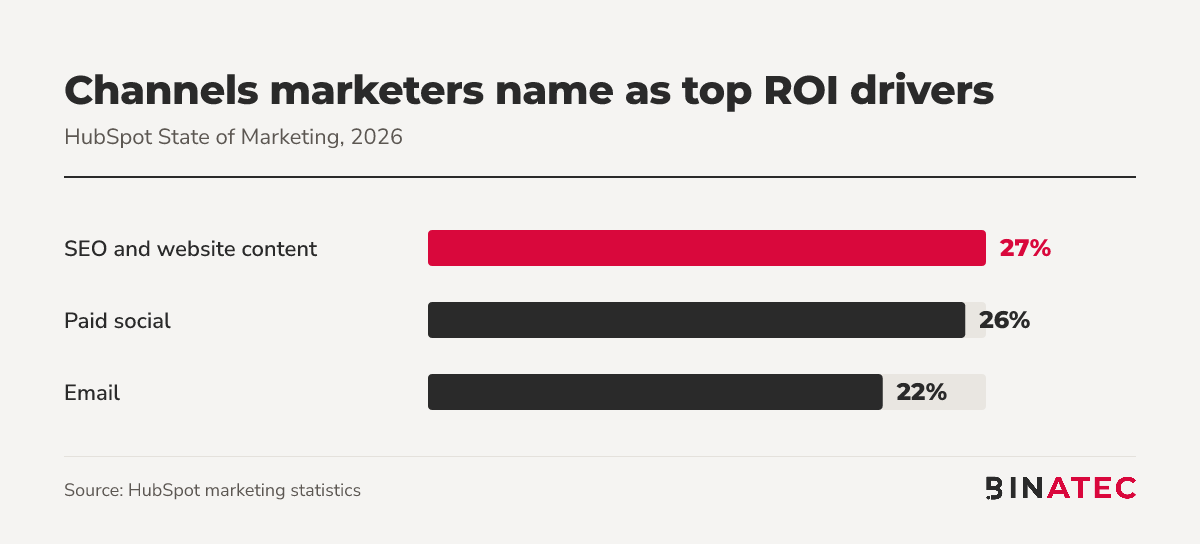
Notice how close they are. These figures are marketers' own opinions rather than measured results, so they show a spread of channels, not a ranking to copy.
A practical way to choose:
- Buyers searching a problem: SEO and Google Ads catch intent already in motion.
- Buyers who haven't started looking: paid social and content create the interest.
- Leads who aren't ready yet: email and lead nurture sequences keep you in the running.
For a wider list of tactics for a small team, see how to get more customers for your small business.
Step 6: Let Your Content Do the Convincing
Buyers research before they ever talk to you. HubSpot's 2026 data says nearly 70% of marketers see leads arriving later in the buying process because of AI-assisted research.
That changes what a good lead looks like. They already know the basics, so your pages, comparisons and case material need to answer harder questions: price ranges, trade-offs, who you're not right for.

Step 7: Track Qualified Leads, Not Form Fills
Forty percent of marketers in HubSpot's 2026 data name lead quality and marketing qualified leads as their most important success metric. There's a reason.
A channel that sends 100 leads who never reply looks great in a report and costs you real sales time. For each source, track how many leads become conversations, then proposals, then customers.
If you can't see that path, start with channel attribution so you know which sources deserve the budget.
Step 8: Test One Change at a Time
Change the headline, then the form, then the offer, and measure each for long enough to see a difference. Changing everything at once tells you nothing.
A conversion rate optimisation routine, even a simple monthly one, compounds quickly because every gain applies to all future traffic.
Lead Generation in Action: A Quick Example
Here's a worked scenario with illustrative numbers, not a client result. A business gets 2,000 visitors a month to a service page and converts 1%, which is 20 leads.
Raise the conversion rate to 2% with a clearer offer and a shorter form and you have 40 leads from the same traffic. Doubling leads through traffic alone would mean paying for another 2,000 visitors.
Now add faster follow-up so more of those 40 turn into conversations. The gain compounds, and none of it needed a bigger ad budget.
When More Traffic Is the Right Answer
Fixing conversion first isn't always right. If you get only a few hundred visits a month, there isn't enough data to test anything, and the bottleneck really is reach.
The same goes for a brand-new offer. Put a small, targeted budget behind it to learn what resonates, then tighten the page. Just keep the follow-up fast from day one.
FAQs
How can I increase lead generation quickly?
Respond to every new lead within minutes, shorten your form, and put one clear offer and button on your highest-traffic page. These changes work on traffic you already have, so you can often see results within weeks rather than months.
What is the best way to generate leads for a small business?
Start where buyers already search: a strong Google Business Profile, a service page that answers their question, and Google Ads for urgent searches. Add email follow-up so you stay in touch with people who aren't ready to buy yet.
How many leads should I get per month?
It depends on your close rate and target revenue. Work backwards: divide the customers you need by your lead-to-customer rate. Tracking that rate is more useful than any industry average, since offers and deal sizes vary widely.
Is paid or organic better for lead generation?
Paid gets leads fast and stops when the budget does. Organic takes longer and builds up over time. Most businesses do best running paid for speed while SEO and content grow underneath it.
Conclusion
The idea to remember: lead generation is a system of offer, page, follow-up and measurement, and the weakest link sets your results.
This week, find your best-trafficked page, time how fast your last five leads got a reply, and fix whichever is worse.
If you'd like a second pair of eyes on your funnel, you can get a free quote and we'll tell you where we'd start. Our go-to-market strategy work covers how these pieces fit together.
Sources
- HubSpot marketing statistics (State of Marketing 2026)
- Unbounce: average landing page conversion rates
- Lead Response Management study


John Doe
Supreb Information. Thanks
15 July 2014 View replies . 1