



Want to show up in Google AI Overviews? Google says there's no special trick. Here are 7 steps, backed by real data, that make your pages easy to cite.
You search for your own service on Google. An AI answer fills the top of the screen, names three competitors, and you're nowhere in it.
Sound familiar? It's one of the most common worries we hear from owners right now, and it's a fair one. Pew Research found that people clicked a regular result in 8% of visits when an AI summary appeared, against 15% when it didn't.
The good news is that Google has told us exactly what it takes to be included, and it's less mysterious than the agency pitches suggest. This guide gives you the short version, then seven steps to follow.
How Do You Show Up in Google AI Overviews?
To show up in Google AI Overviews, your page must be indexed and eligible to appear in Google Search with a snippet. Google says there are no extra requirements. In practice that means crawlable pages, clear answers in plain text, a topic covered from several angles, and enough trust that Google wants to quote you. Inclusion is never guaranteed.
Key Takeaways
- Google's own documentation says there are no additional requirements for AI Overviews beyond being indexed and snippet-eligible, and no special schema markup is needed.
- Ranking in the top 10 helps but doesn't decide it: Ahrefs found only 37.9% of cited URLs also sat in the top 10 results.
- Google increasingly pulls from pages that answer related follow-up questions, so covering a whole topic beats chasing one keyword.
- Short, direct answers placed under clear headings are easiest for Google to lift, and they also win featured snippets and People Also Ask boxes.
- AI summaries cut clicks to regular results, so being cited matters most for brand visibility and for questions where buyers are already close to deciding.
- You can check your own presence in minutes, using Search Console and a handful of manual searches.
What Google Actually Says About AI Overviews
Start with the source. Google's AI features documentation says a page has to be indexed and eligible to be shown in Search with a snippet to be a supporting link in AI Overviews or AI Mode.
It also says there are no additional requirements, and that you don't need special files, AI text files or any particular schema.org markup. Standard SEO fundamentals apply.
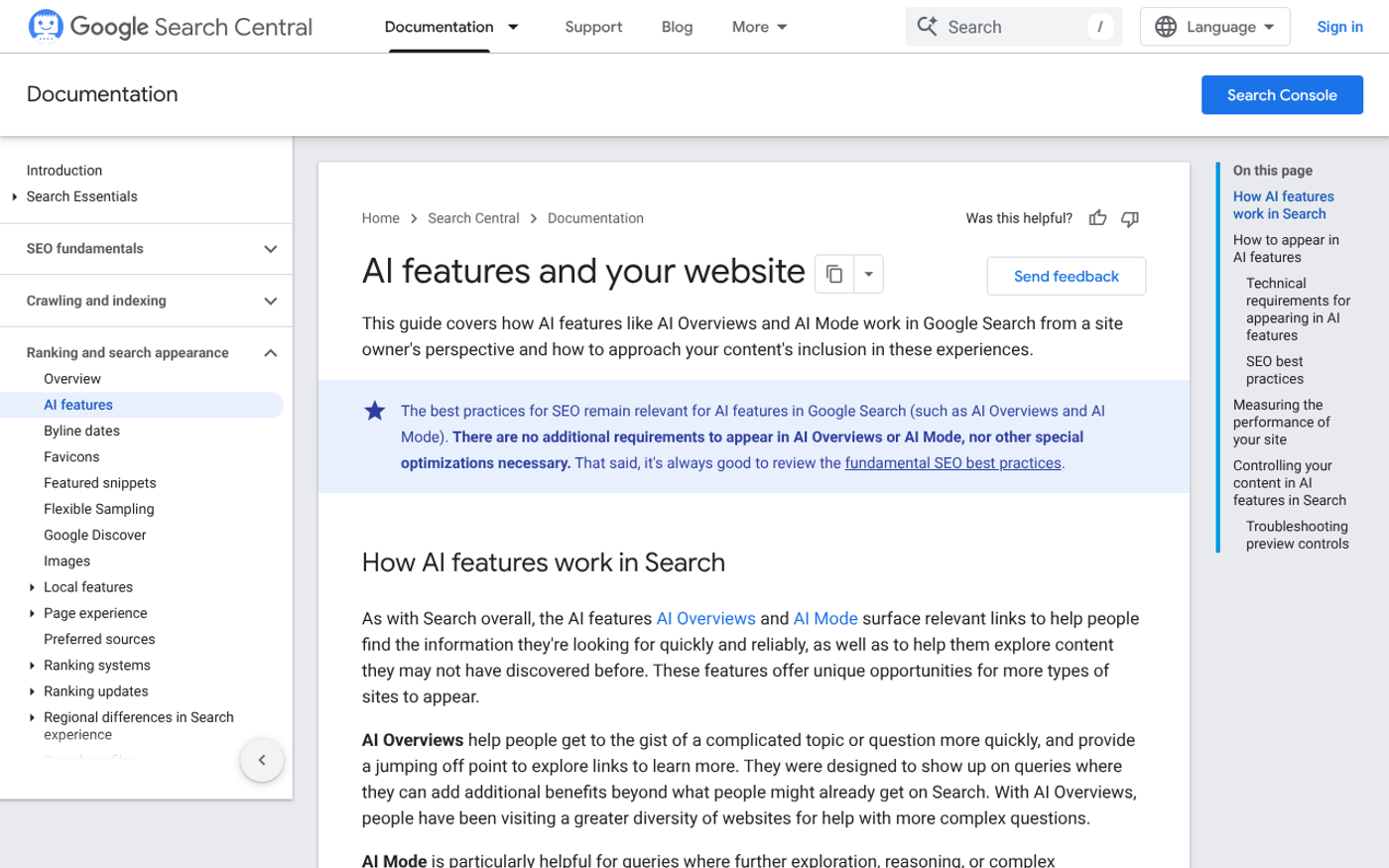
So anyone selling you a secret AI Overview file or a proprietary markup trick is guessing. Spend that money on content and technical basics instead.
Step 1: Make Sure Google Can Crawl and Index the Page
This is the entry ticket. Google says to check that crawling is allowed in robots.txt and by any CDN or hosting layer in front of your site, and that important content is available as text.
Three quick checks:
- Open the URL Inspection tool in Search Console and confirm the page is indexed.
- Look at the HTML Googlebot receives, not just what you see in a browser, to confirm your key text is in it.
- Make sure you haven't set `nosnippet` or a tiny `max-snippet` on pages you want quoted.
If your site needs a proper audit, our technical SEO work starts exactly here.
Step 2: Answer the Question in the First Lines
Put a 40-60 word direct answer right under the heading that asks the question. Then expand. This is the same pattern that wins featured snippets, and it gives Google a clean passage to quote.
Write it plainly. Lead with the answer, name the thing, skip the warm-up.
Step 3: Cover the Whole Topic, Not One Keyword
Here's the part most guides miss. Ahrefs studied about 4 million AI Overview URLs across 863,000 keyword results and found cited pages often don't come from the top 10 for the original keyword.
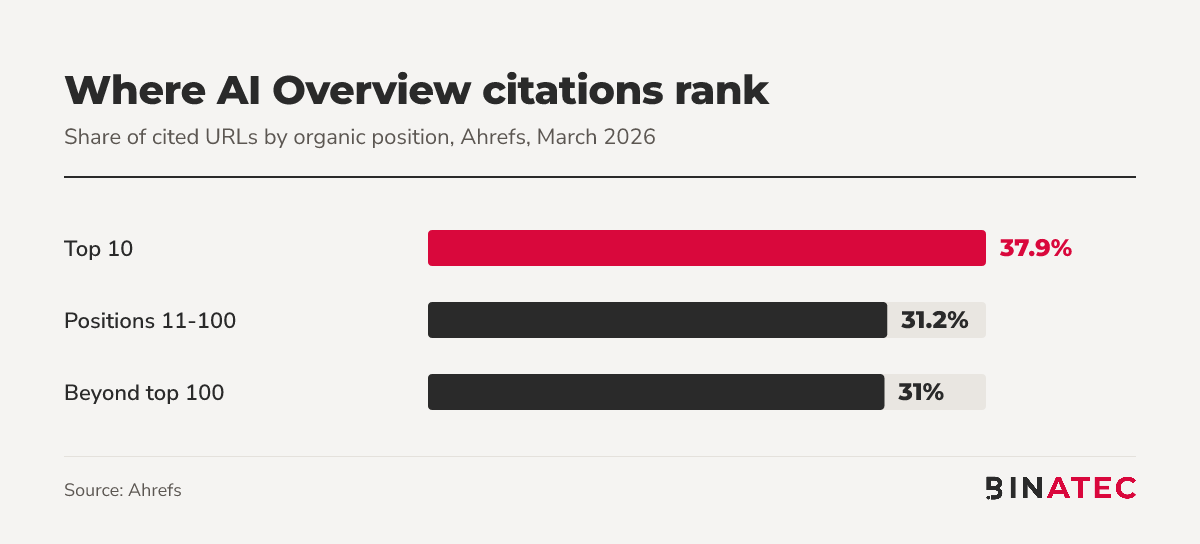
Ahrefs suggests Google increasingly draws on the results for related follow-up searches, which it calls fan-out queries. Its advice: stop optimising for single keywords and cover the whole user journey.
In practice, list the 8-10 follow-up questions a buyer asks after the main one, and answer each with its own heading. That is also how our GEO optimization work is scoped.
Step 4: Target the Questions That Trigger AI Answers
AI summaries don't appear on every search. Pew found they were far less common on one- or two-word searches, and more common on longer, question-style queries.
That points at the content you should write first: full questions such as "how much does X cost" or "which is better, X or Y". Check our cost guides and comparison posts for the format.
Step 5: Format for Easy Extraction
Google can only quote what it can parse. Make passages self-contained and scannable:
- Use numbered lists for steps and tables or bullets for comparisons.
- Keep one idea per paragraph, in 1-3 short sentences.
- Give each section a plain heading that matches how people ask the question.
- If you use structured data, keep it consistent with the visible text, as Google advises.

Step 6: Build Trust Beyond Your Own Site
Ahrefs found YouTube is now the most cited domain in AI Overviews, and says brand mentions there correlate strongly with AI Overview visibility. That doesn't mean everyone needs a channel.
It does mean Google looks past your website. Reviews, a complete Google Business Profile, an honest author page and mentions on sites your buyers trust all help. Our guide to getting cited by ChatGPT covers the overlap, because the same signals work across assistants.
Step 7: Check That You're Showing Up
Don't guess. Pick your 10 most valuable questions and search each one in a private window. Note if an AI Overview appears and if you're linked.
Then repeat monthly in the same spreadsheet. Ahrefs recommends reviewing your own citations to spot pages that rank but aren't cited. Those are your quickest rewrites.
AI Overviews in Action: A Quick Example
Say you run a bookkeeping firm with a page titled "Bookkeeping Services". It ranks, but it never answers a question.
Here's the rebuild. Retitle it around a real question, such as "How much does a bookkeeper cost for a small business?". Open with a 50-word answer. Add headings for the follow-ups: monthly versus hourly pricing, what's included, and when to hire in-house. End with FAQs.
Nothing in that rebuild is a trick. It's the same page, made easier to quote. That's the whole approach.
When This Advice Doesn't Apply
Be realistic about the upside. Pew found only about 1% of visits to pages with an AI summary included a click on a link inside the summary.
So being cited builds awareness more than traffic. If your sales depend on instant clicks, keep paid search and strong organic rankings in the mix. And if you'd rather keep content out of AI answers, Google's opt-out controls are worth reading first.
Also remember nobody can promise inclusion. Google itself says indexing and serving isn't guaranteed.
FAQs
Do I need schema markup to appear in AI Overviews?
No. Google says there is no special schema.org structured data you need to add for AI Overviews. If you use markup for other reasons, keep it consistent with what's visible on the page.
Do I need to rank number one to be cited?
No. Ahrefs found only 37.9% of cited URLs also ranked in the top 10, and the rest ranked lower or outside the top 100 for the original keyword. Strong rankings still help, but they aren't the only route.
How long does it take to show up?
Google says recrawling can take anywhere from several days to several months. Content changes to pages that already rank can be picked up sooner than brand new pages, so update existing winners first and be patient.
Can I pay to be in AI Overviews?
No. Supporting links in AI Overviews are earned through Search eligibility, not bought. Ads can appear in or around AI answers, but that's a separate paid product from organic citations.
Conclusion
There's no hack here. Get indexed, answer questions directly, cover the whole topic and earn trust off your own site.
This week, pick your five most valuable pages and add a direct answer and three follow-up sections to each. Then run the private-window check in Step 7 to set your baseline.
If you'd like help with the audit, our SEO team can do it, and you can get a free quote whenever you're ready.
Sources
- Google Search Central: AI features and your website
- Ahrefs: AI Overview citations and top 10 rankings
- Pew Research Center: Google users are less likely to click on links when an AI summary appears


John Doe
Supreb Information. Thanks
15 July 2014 View replies . 1