



Is your email open rate fake? Apple's privacy feature inflates opens. See the true B2B rate and the four metrics that show real interest in 2026.
Your last email campaign shows a 45% open rate. Your sales team says nobody is replying. Both can be true at the same time.
Sound familiar?
The open rate in your dashboard is counting something that never happened: emails opened by a machine, not a person. If you've been judging campaigns, subject lines or whole lead lists by that number, you've been steering by a broken gauge.
This post shows how big the distortion is, what the better numbers are, and how to rebuild your email reporting around them without buying another tool.
Key Takeaways
- Apple's Mail Privacy Protection loads tracking pixels automatically, so Litmus estimates it affects roughly 55-60% of all email opens.
- Stripo's 2026 research review estimates the true B2B open rate sits around 15-25%, far below the 40%+ many dashboards report.
- Treat open rate as a deliverability signal only: a sudden drop can warn you about inbox placement, but a high number proves nothing.
- Click-to-open rate, replies and booked meetings show real interest, and none of them can be faked by a pre-loading mail app.
- Benchmarks from different vendors disagree by up to 28 points, so compare against your own trend, not someone else's average.
Why Your Open Rate Is Lying to You
An open is recorded when a tiny invisible image in your email loads. For years that meant a person had looked at the message.
Then Apple changed the rules. Since iOS 15 in September 2021, Apple Mail Privacy Protection preloads that image whether or not the recipient reads anything, according to Stripo's 2026 research review. Your email platform logs a perfectly normal open. Nobody was there.
Apple Mail and Gmail together make up nearly 90% of email client market share, based on Litmus's analysis of more than a billion opens. Litmus also reports that Apple's privacy feature affects roughly 55-60% of all opens, though it doesn't name the studies behind that range.
So more than half of the data feeding your open rate may be noise.

How Big Is the Distortion?
Big enough to change decisions. Stripo's review pulled together 26 sources covering about 15 billion emails. It estimates the true, human B2B open rate at 15-25%, and that machine opens inflate B2B open rates by 15-20 points or more.
The same review notes that sources disagree by up to 28 points. That isn't because anyone is lying. They measure different things: cold sales emails versus opted-in newsletters, B2B versus mixed audiences.
Here's what that looks like in practice. MailerLite's data, as reported by Stripo, shows open rates well above what most B2B teams believe their emails really achieve.
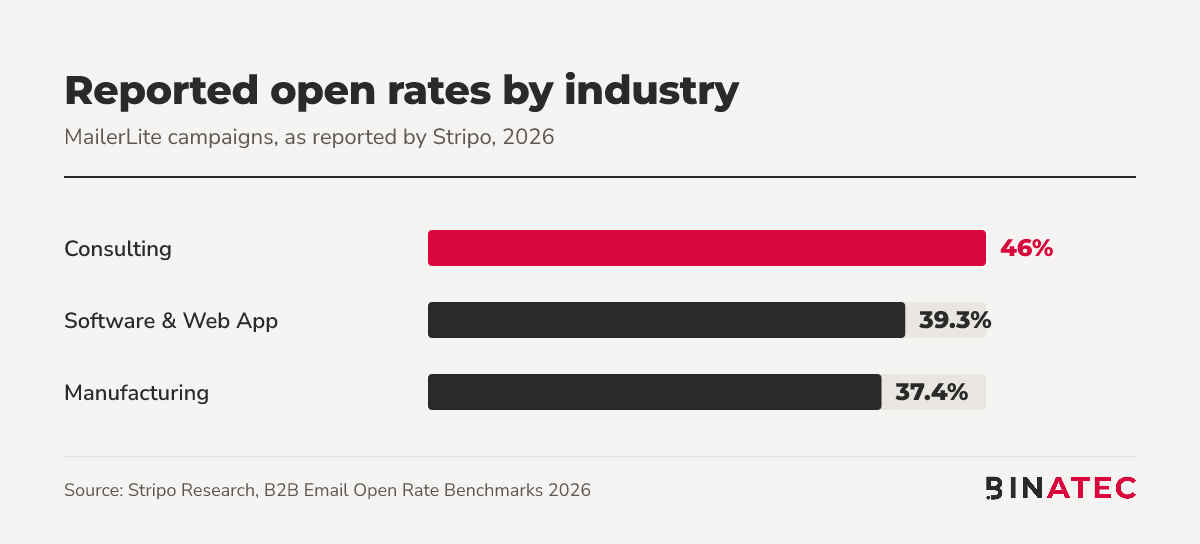
Those figures are the ones that look great in a report. They are also the ones most likely to include machine opens.
What Does the Open Rate Still Tell You?
It isn't useless. It just answers a different question than the one most teams ask.
The open rate can't tell you whether people care. It can tell you whether your emails are reaching inboxes at all. If it falls off a cliff overnight, something has changed with your sending domain, your list quality or your spam placement.
That's why Stripo recommends treating open rate as a deliverability signal and judging performance with other metrics.
The Metrics to Track Instead
Four numbers do the job better. Each needs a human to act.
1. Click-to-open rate
Click-to-open rate (CTOR) divides clicks by opens. Stripo's review reports a B2B average of 6.81% and calls it the most reliable engagement measure of the lot. It still uses opens in the denominator, so watch the trend rather than the absolute figure.
2. Reply rate
For outreach and nurture, replies are the cleanest signal there is. Instantly's 2026 benchmark report, as cited in its guide, puts the average cold email reply rate at 3.43%, with the top quartile at 5.5%. Treat that as a rough guide: the guide doesn't publish its sample size or method.
3. Booked meetings or demo requests
Count the outcome you actually want. A campaign with a 20% open rate and six booked calls beats one with a 50% open rate and none.
4. Clicks to a page that matters
Send people to a specific page and track what they do there. A click to your pricing page tells you far more than an open ever did.
Rebuild your reporting in four steps:
- Open your email platform and find the report that shows opens, clicks and replies side by side.
- Add click-to-open rate and reply rate as columns, and drop open rate from your headline number.
- Connect link clicks to conversions in your analytics so each campaign has a pipeline figure.
- Review the trend monthly, not campaign by campaign.
Reporting in Action: A Quick Example
Picture two campaigns sent to the same mixed list.
Campaign A reports a 48% open rate and a 1% click rate. Campaign B reports a 31% open rate and a 4% click rate.
On open rate alone, A wins by a mile. But if more than half the opens are machine-generated, that 48% is mostly noise. B's clicks are all human, and they point to a subject line and offer that people actually acted on.
Now add the downstream numbers. If B also drives more replies and booked calls, the decision is easy: copy B.
This is illustrative, not a client result. The point is the order of operations: outcomes first, clicks second, opens last.
Where This Breaks Down
Don't throw opens away entirely.
If you're a small sender with a short list, open data can still help you spot a deliverability problem early. And if your audience skews toward non-Apple clients, the inflation will be smaller.
Clicks have their own flaws, too. Security scanners at some companies click links automatically, which can inflate click counts in B2B. If you see a burst of clicks within seconds of sending, check before you celebrate.
No single email metric is clean. Use several and look for agreement.
What This Means for Your Lead Nurture
If your nurture sequences branch on opens (for example, sending a follow-up only to people who opened), you're probably branching on machine behaviour. Switch the trigger to a click, a reply or a page visit.
The same goes for list cleaning. Removing subscribers who 'never open' can wrongly cut real readers who simply use Apple Mail's privacy setting, and keeps the fake openers in. Build your suppression rules on clicks and conversions over a longer window instead.
This is the kind of fix we build into lead nurture sequences and email marketing programmes at Binatec, and it ties directly to how you measure channel attribution.
FAQs
Why is my email open rate so high?
Most likely because of machine opens. Apple Mail Privacy Protection preloads tracking images, so your platform records opens that no person made. Litmus estimates the feature affects roughly 55-60% of all opens, which can push reported open rates far above real reader behaviour.
What is a good B2B email open rate in 2026?
Stripo's review of 26 sources estimates a true human B2B open rate of about 15-25%. Dashboards often show 35-45% or more because of machine opens. Benchmarks vary by up to 28 points, so compare against your own past campaigns instead.
What should I track instead of open rate?
Track click-to-open rate, reply rate, booked meetings and clicks to key pages. These need a real person to act. Keep open rate only as a deliverability check, so you notice if emails start missing the inbox.
Does Apple Mail Privacy Protection affect click tracking?
Not in the same way. The feature preloads images, which creates false opens, but it doesn't click your links. That is why clicks, replies and conversions are more reliable. Watch for corporate security scanners, which can occasionally trigger link clicks.
Conclusion
Open rate used to measure attention. Now it mostly measures whether a mail app pre-loaded an image.
This week, pull your last five campaigns and rank them by clicks, replies and booked calls instead of opens. If the order changes, you've just found what your reporting has been hiding.
If you'd like help building email reporting that ties to revenue, get a free quote and we'll take a look.
Sources
- Stripo Research: B2B Email Open Rate Benchmarks 2026
- Litmus: Email Client Market Share
- Instantly: Email Sequence Benchmarks 2026


John Doe
Supreb Information. Thanks
15 July 2014 View replies . 1