



63% of B2B tech buyers used AI to research purchases, yet 94% fact-check it. See who they trust and how to fix your go-to-market plan this quarter.
Have you noticed your prospects showing up to the first call already knowing your pricing, your competitors and the three objections they plan to raise?
They didn't get that from your sales deck. A lot of it came from an AI chat window, a handful of review pages and a conversation you never saw.
A big new survey shows how that research really works. The headline isn't "AI is taking over". It's more useful than that: buyers use AI to move faster, then check the answer against sources they trust.
This post breaks down what the data says, where most go-to-market plans leak, and what to change before the end of the quarter.
Key Takeaways
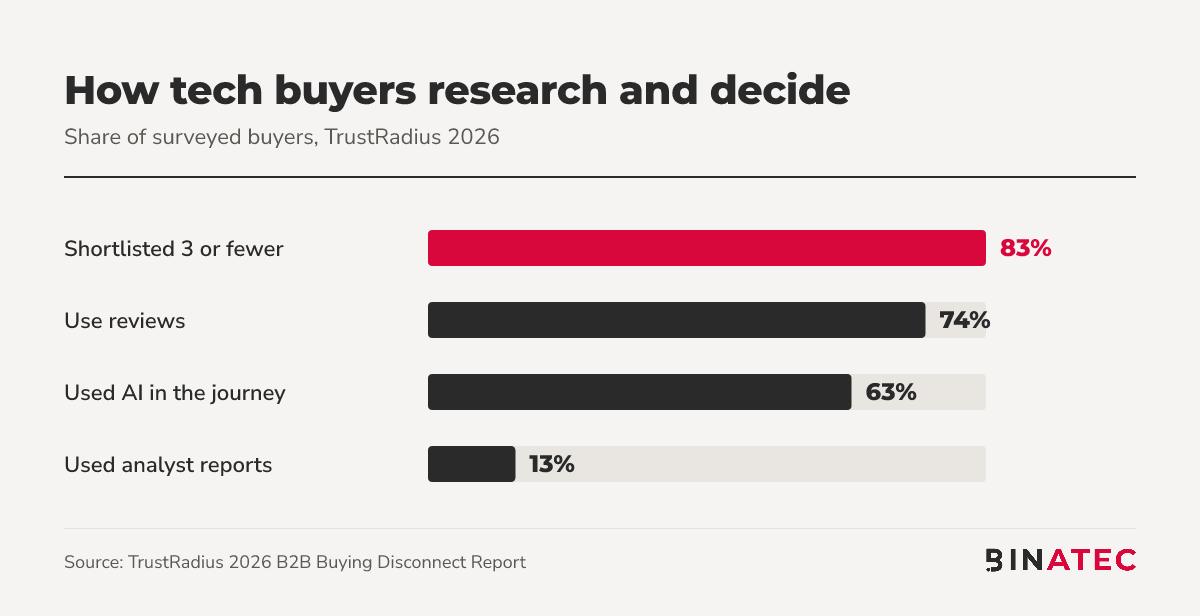
- According to TrustRadius, 63% of tech buyers used AI during their purchase journey, so ignoring AI research is no longer an option.
- The same survey found 94% of buyers who used AI fact-check its answers at least some of the time, so AI opens the door but doesn't close the deal.
- Reviews still carry weight: 74% of buyers use them to inform decisions, and AI answers lean heavily on third-party content like reviews and independent publications.
- Shortlists are tiny. 83% of buyers shortlisted three or fewer products, which means missing the first list often means missing the sale.
- Buyers say they want transparent pricing, and they've ranked it first on their wish list for four years running.
- Your go-to-market plan needs one owner for the evidence buyers check, not just the channels that bring them in.
What the Survey Actually Found
The TrustRadius 2026 B2B Buying Disconnect Report was released on July 15, 2026. It surveyed 1,862 technology buyers and 444 technology vendors in January 2026, covering purchases made over the previous year.
It's a tech-buying study, so don't copy the numbers straight onto a plumbing supplier. But the behaviour it describes is showing up wherever a purchase involves research and risk.
Here's the pattern in one line. Buyers use AI to build context quickly, then lean on demos, free trials, past experience and user reviews to decide. Rajat Bhatnagar of HG Insights put it this way: "Buyers are using AI to move faster, not to think less."
Why AI Research Doesn't Replace Trust
The most telling number is the 94%. Nearly every buyer who used AI checked what it told them.
That check has to go somewhere. According to the same report, buyers rank product demos, free trials, prior experience and user reviews as the most influential resources. The report also notes that AI recommendations are heavily shaped by third-party content, such as customer reviews, independent publications and peer experiences.
So there are two audiences reading your proof: the buyer, and the AI that summarises you for the buyer. Both look at what others say about you.
Meanwhile, analyst reports are fading. TrustRadius reports that 13% of buyers used them, a 63% drop since 2022. If your credibility plan leans on a PDF from an analyst, it's reaching fewer people each year.

The Shortlist Is Where Deals Are Won
With 83% of buyers shortlisting three or fewer products, the first list does most of the filtering.
G2's survey of more than 1,000 B2B software buyers, fielded in August 2025, pushes the same point from another angle. It found 87% said AI chatbots are changing how they research, and 50% said they start their buying journey in an AI chatbot instead of Google Search. G2 reports that as a 71% increase over a survey four months earlier.
That's G2's own survey of software buyers, so treat it as a direction rather than a universal rule. The direction is still clear.
If the shortlist is formed before anyone visits your site, your job moves earlier. You need to be named, described accurately and backed by proof in the places the shortlist is built.
Where Most Go-to-Market Plans Leak
Most plans are built around channels: SEO, paid, email, outbound. Each has a target and a report. Almost none has an owner for the evidence buyers check.
The survey hints at a related gap. TrustRadius found buyers rank data accuracy as the top success measure for go-to-market data, while vendors rank total closed-won business first. Both are reasonable. They're also different scoreboards, and that mismatch is how teams spend months optimising for what buyers never notice.
Here are the four leaks we see most often when we review a plan:
- No public pricing guidance. Buyers have named transparent pricing their top wish for four straight years, and a hidden price is a reason to drop you from a list of three.
- Thin or stale reviews. If your last review is 14 months old, both buyers and AI summaries see a quiet company.
- Inconsistent descriptions. Your site, profiles and listings say slightly different things about who you serve.
- No self-serve proof. Buyers value demos and trials, yet many sites hide them behind a form and a three-day wait.
A Practical Fix: Build Your Evidence Pack
Think of an evidence pack as everything a sceptical buyer would want to check in ten minutes. It's cheaper than another channel, and it improves every channel you already run.
Step 1: Write down the buyer's checks
List the five questions a new prospect asks before they'll book a call. Price range, fit, proof, risk, time to value. Then find where each is answered today.
Step 2: Fix the gaps you control
Publish a pricing range or a clear "from" figure with what changes it. Put a real example or demo on a page that needs no form. Tighten your positioning so one sentence describes who you help. Our Go-to-Market Strategy work starts with exactly this audit.
Step 3: Earn the proof you don't control
Ask recent happy customers for specific reviews on the sites your buyers use. A review that names the problem and result is worth more than five that say "great service". Never write them yourself or offer anything that breaks a platform's rules.

Step 4: Check what AI says about you
Ask the major AI chat tools the questions your buyers ask: "best [your category] for [your customer]". Note if you're named, what's said and which sources are cited. Our GEO optimisation service covers this in depth.
The Evidence Pack in Action: A Quick Example
Picture a B2B software firm that sells a scheduling tool to clinics. It has strong outbound and decent SEO, but no pricing on the site, six reviews all from 2024, and a demo that takes three days to book.
A prospect asks an AI tool for scheduling software for clinics. The answer cites a couple of review sites and a competitor's pricing page. This firm isn't on the list of three.
The fix isn't a new ad campaign. It's a pricing range, a self-serve demo, a review request to the last 20 customers and one consistent description everywhere. That's a month of work, and it's illustrative only, not a result we've measured.
When This Advice Doesn't Apply
Not every business sells through research. If you sell a low-risk, impulse-priced product, buyers won't run a ten-minute check, and creative and reach matter more.
Likewise, the TrustRadius sample is technology buyers. A local service firm should test the idea with its own customers: ask your last ten clients how they found you and what they checked first. Five minutes of that is worth more than any benchmark.
FAQs
Do B2B buyers really use AI to research purchases?
Yes, many do. TrustRadius found 63% of tech buyers used AI during their purchase journey, and G2 found 87% of software buyers say AI chatbots are changing how they research. Both are surveys of technology buyers, so check how your own customers behave.
Do buyers trust AI answers?
Mostly with a check. According to TrustRadius, 94% of buyers who used AI fact-check its responses at least some of the time. They use it to move faster, then confirm with reviews, demos, trials and past experience.
How many vendors do buyers shortlist?
Very few. TrustRadius reports 83% of buyers shortlisted three or fewer products. That makes the early research stage, including what AI tools and review sites say about you, the point where many deals are won or lost.
What should I fix first in my go-to-market plan?
Start with what buyers check before they talk to you: pricing clarity, recent reviews, a self-serve demo and a consistent description of who you serve. These are cheap, fast and help every channel you already run.
Conclusion
AI hasn't changed what buyers trust. It's changed how quickly they get to the point where they check.
This week, ask your last five customers what they checked before booking a call, then fix the biggest gap on that list. If you'd like help turning it into a plan, you can get a free quote and we'll take a look.
Sources
- TrustRadius 2026 B2B Buying Disconnect Report (via HG Insights)
- G2: How AI Chat is Rewriting B2B Software Buying


John Doe
Supreb Information. Thanks
15 July 2014 View replies . 1