



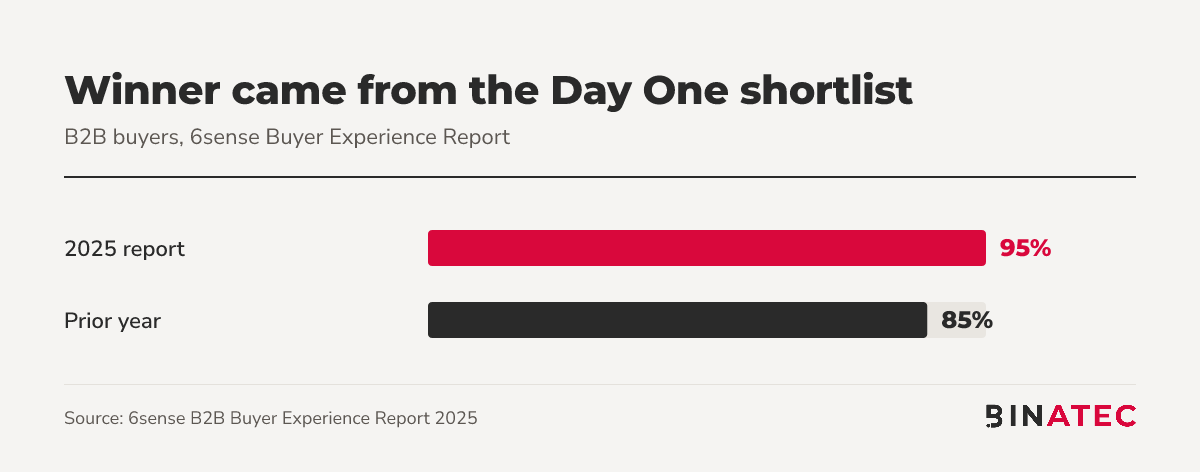
6sense found 95% of B2B buyers choose a vendor from their Day One shortlist. Here's what that means for your go-to-market plan, and how to get on the list.
Picture a buyer at a company like your best-fit customer. Before anyone has filled in a form, booked a demo or opened your pricing page, they already have a short list of vendors in their head.
If you're not on it, your sales team never gets the chance to compete. Sound familiar?
That's not a scare story. In 6sense's 2025 Buyer Experience Report, which surveyed nearly 4,000 B2B buyers, 95% of winning vendors came from the buyer's Day One shortlist. A year earlier it was 85%.
So the real go-to-market question isn't how to win the deal once a lead arrives. It's how to be remembered before the buyer starts looking. This post shows what the data says, what it means for where you spend money, and a practical plan for this quarter.
Key Takeaways
- According to 6sense, 95% of the time the vendor a buyer chooses was already on their Day One shortlist, up from 85% the year before.
- Buyers now first contact a seller about 61% of the way through their journey, down from 69%, but they've usually formed a view of who they like by then.
- The vendor contacted first won 77% of deals in the main survey, and 94% when the buyer had already ranked their shortlist by preference.
- 94% of buyers used large language models during the buying process, mostly mid-journey to compare vendors, so your positioning has to survive being summarised.
- Most of your pipeline is decided before you see a lead, so brand, search visibility and proof matter as much as outbound and paid.
- You can act on this now: define who you want on the list, check where you appear, and fix the gaps in your proof and positioning.
What Is the Day One Shortlist?
The Day One shortlist is the set of vendors a buyer names at the very start of a purchase, before any formal research. Think of it as the first few names that come to mind when someone says "we need a tool for this" or "we need an agency for that".
6sense's report found buyers evaluated 5.1 vendors on average and filled 3.6 of those spots on Day One. Buyers had also used 3.8 of the vendors they evaluated before.
In other words, most of the shortlist is built from memory and past experience, not from fresh Google searches.
Why Buyers Contact You Later Than You Think
The same report says the first contact with a seller now happens about 61% of the way through the journey, compared with 69% the year before. That's roughly 27 weeks in, about 6 to 7 weeks sooner than before.
It sounds like good news, because buyers are talking to sellers earlier. But 79% of those first contacts were started by the buyer, not the seller. They came to you because they'd already decided you were worth a call.
That's the trap in lead-based reporting. A form fill looks like the start of the journey. For the buyer, it's the middle.
The First Vendor in the Door Usually Wins
6sense reports that the vendor contacted first won 77% of deals in its main survey, and 81% in a smaller companion survey of 766 buyers.
When the buyer had ranked the shortlist by preference before first contact, the first vendor won 94% of the time. When they hadn't, it was 57%.
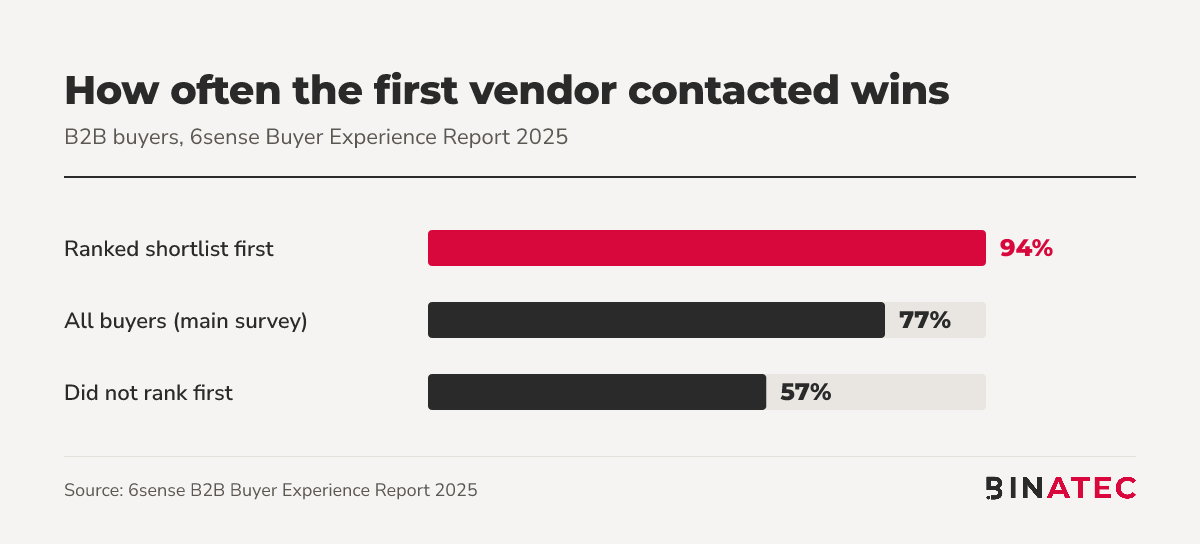
The takeaway: a buyer with a clear favourite rarely changes their mind. A buyer without one is still persuadable. Your job is to become the favourite before the conversation, and to be quick when the undecided ones show up.
How AI Fits Into the Picture
In a 6sense write-up on the same data, 94% of surveyed buyers said they used LLMs during their buying journey. The main uses were comparing vendor offerings, evaluating proposals and summarising third-party content.
The author notes that this happens mainly mid-journey, not at the start. AI rarely names the first few vendors. It helps buyers sort the ones they already know.
That makes clear, consistent positioning more valuable. If a model summarises your offer next to two rivals, can a stranger tell why you're different in two sentences? Our GEO and AI search work starts with exactly that check.

How to Get Onto the Day One Shortlist
You can't buy a place on the list with one campaign. You earn it by being easy to remember and easy to trust over months. Here's a plan that fits inside a quarter.
Step 1: Name the accounts that matter
Write down the 50 to 200 companies you'd love as customers. A shortlist is built by people at specific companies, so reach those people on purpose. This is the logic behind account-based marketing.
Step 2: Pick one thing to be known for
Buyers remember a single clear idea, not a list of twelve services. Decide what category or problem you want to be the first answer to, then say it the same way on your site, your LinkedIn page and your sales deck. A go-to-market strategy is where that decision gets made.
Step 3: Be visible where shortlists form
Search, peer recommendations, communities and content all feed memory. Make sure the questions your buyers ask have a good answer on your site, which is what SEO does for you.
Step 4: Make your proof easy to find
Case studies, numbers and named customers help a buyer defend a choice to their team. 6sense's author recommends making positioning, messaging and proof points easy to access and compare.
Step 5: Be ready when they call
Since the first vendor in often wins, speed matters. Reply to enquiries the same day, and have a short, specific answer ready for "why you?".
A Quick Example: Reading Your Own Pipeline
Take your last five won deals and ask each customer one question: "Who else did you have in mind before you contacted us?" Write down the answers.
If the same competitor names keep appearing, you've found who owns the shortlist in your category. If your name came up before the enquiry, find out where they heard of you, and do more of that.

Where This Breaks Down
Two caveats. First, this is survey data: buyers describe what they remember, and the figures come from 6sense's own research into purchases averaging around $250,000 a year, per the company's write-up. That's bigger than many Binatec clients buy.
Second, if you sell a low-priced product or a new category, buyers may build their list by searching on the day. In that case search visibility and ads matter more. Don't copy these numbers into your plan without checking them against your own closed deals.
FAQs
What is a Day One shortlist in B2B buying?
It's the group of vendors a buyer already has in mind when a purchase starts, before formal research. 6sense found buyers fill about 3.6 of their 5.1 evaluated spots on Day One, and 95% of winners come from that list.
Does this mean demand generation and ads don't work?
No. It means they work by building memory before the buyer is in market, not only by capturing leads. Ads, content and outreach all help you get remembered. Judge them on whether you appear on lists, not just on form fills.
How early do B2B buyers contact sellers?
According to 6sense's 2025 report, about 61% of the way through the journey, or roughly 27 weeks in, compared with 69% the year before. Most of that first contact was started by the buyer.
How do I measure whether I'm on the shortlist?
Ask new customers and lost prospects who else they considered and where they first heard of you. Add it as a required field in your CRM. It's cheap, and it shows what your attribution reports miss.
Conclusion
Most deals are shaped before your first conversation. The idea to remember: your marketing's job is to get you on the list, and your sales team's job is to keep you there.
This week, ask your last five customers who else they had in mind and where they heard of you. Then pick the one gap that shows up most.
If you'd like a second pair of eyes on your go-to-market plan, you're welcome to get a free quote.
Sources
- 6sense: The B2B Buyer Experience Report for 2025
- 6sense: Stop Panicking: How B2B Buyers Really Use LLMs


John Doe
Supreb Information. Thanks
15 July 2014 View replies . 1