



A study of 14,000 AI answers shows whether your brand gets named depends on the type of question asked. Here's how to find which questions matter for you.
You ask ChatGPT for the best provider in your category and your brand is there. Great. You ask it again an hour later and you're gone.
Sound familiar? Plenty of marketers are running these spot checks right now and drawing big conclusions from a single answer.
A new study of 14,000 AI responses suggests that's the wrong way to look at it. Whether AI names your brand has less to do with luck, and more to do with what kind of question the buyer asks.
This post breaks down what the study found, what it means for your content, and a simple way to test your own brand this week.
Key Takeaways
- Conductor's study found that the type of question predicts how consistent AI brand mentions are, more than the industry does.
- Purchase questions were the least stable: only 40% of brands in one answer appeared in a second run of the same prompt.
- Comparison questions were the most stable for the leader: the same brand came first 91% of the time.
- Between 45% and 72% of educational prompts returned no brand names at all, depending on the AI engine.
- One manual check tells you almost nothing, so track the same set of questions repeatedly and by question type.
- Your content job changes by question type: win the comparisons, teach on the educational queries, and be the obvious pick on recommendations.
What Did the Study Actually Test?
Conductor ran 14,000 API calls across 10 industries, 7 types of buyer intent and 4 AI engines: ChatGPT, Perplexity, Claude and Gemini. Each prompt was run 50 times, and each run started fresh with no conversation history, according to the study write-up.
It measured two things. Brand overlap is how many of the same brands show up in two runs of the same prompt. Lead brand stability is how often the same brand comes first.
It also challenges an earlier January 2026 study from SparkToro, which concluded that industry size was the best predictor of consistency. Conductor's data points to intent instead, and the ranking held across all four engines and all 10 industries.
One caveat before we go on. Conductor used the same standard prompt for every industry, which makes the comparison clean but may not match how your customers actually phrase things. Treat the numbers as a pattern, not a promise.
Why Question Type Changes Everything
Think about how your own buyers search. Someone learning about a problem asks a different kind of question than someone ready to buy. AI treats them differently too.
Conductor reports that purchase prompts had the lowest brand overlap at 40%, while comparison prompts had the highest at 63%. In plain terms, when a buyer is ready to purchase, the list of brands AI offers shifts a lot from one answer to the next.
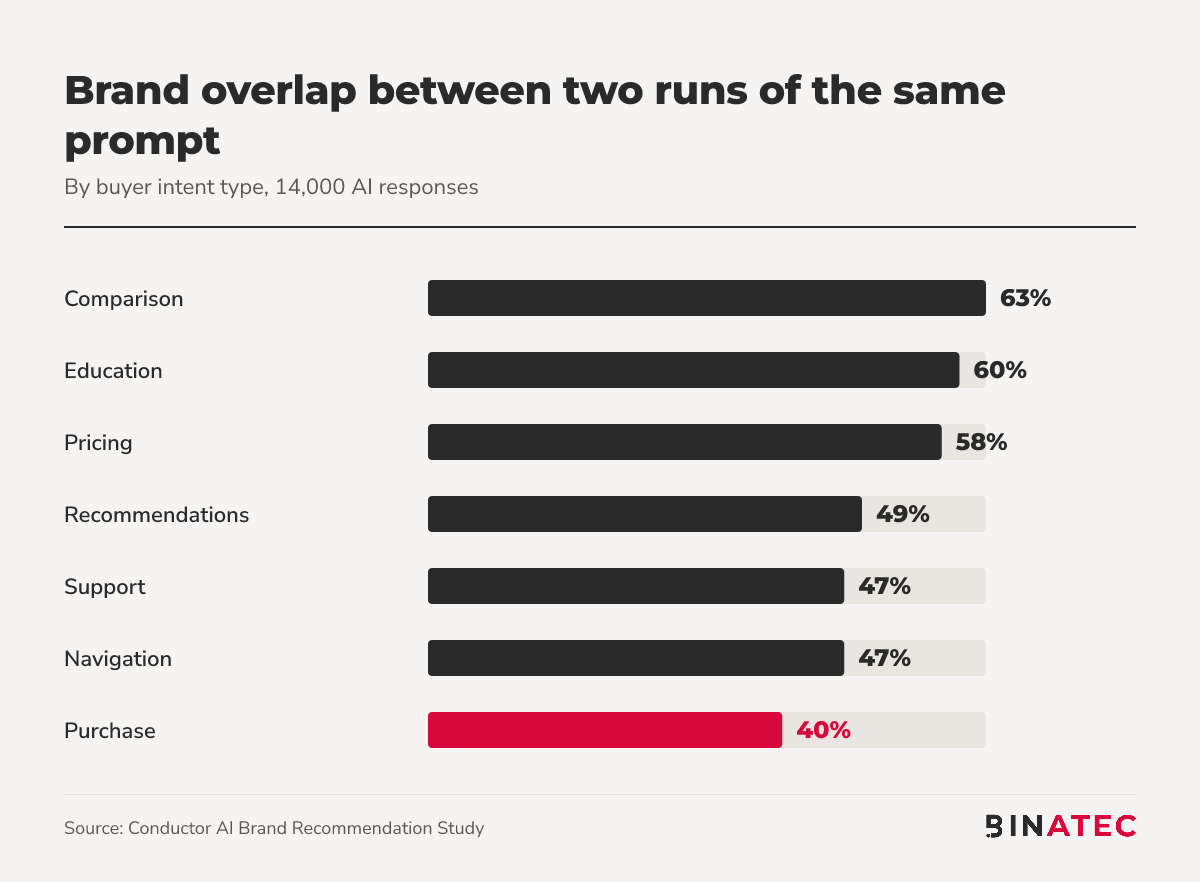
That's why a single check misleads you. Ask a purchase question once and you might see your brand, or you might not. Neither result is the truth.
Who Wins Each Type of Question?
Overlap only tells you whether the list of brands is stable. It doesn't tell you who gets named first. For that, look at lead brand stability.
Comparison prompts are the most winner-takes-all: the same brand led 91% of the time in the study. Educational prompts were the opposite. The same brand led only 30% of the time.
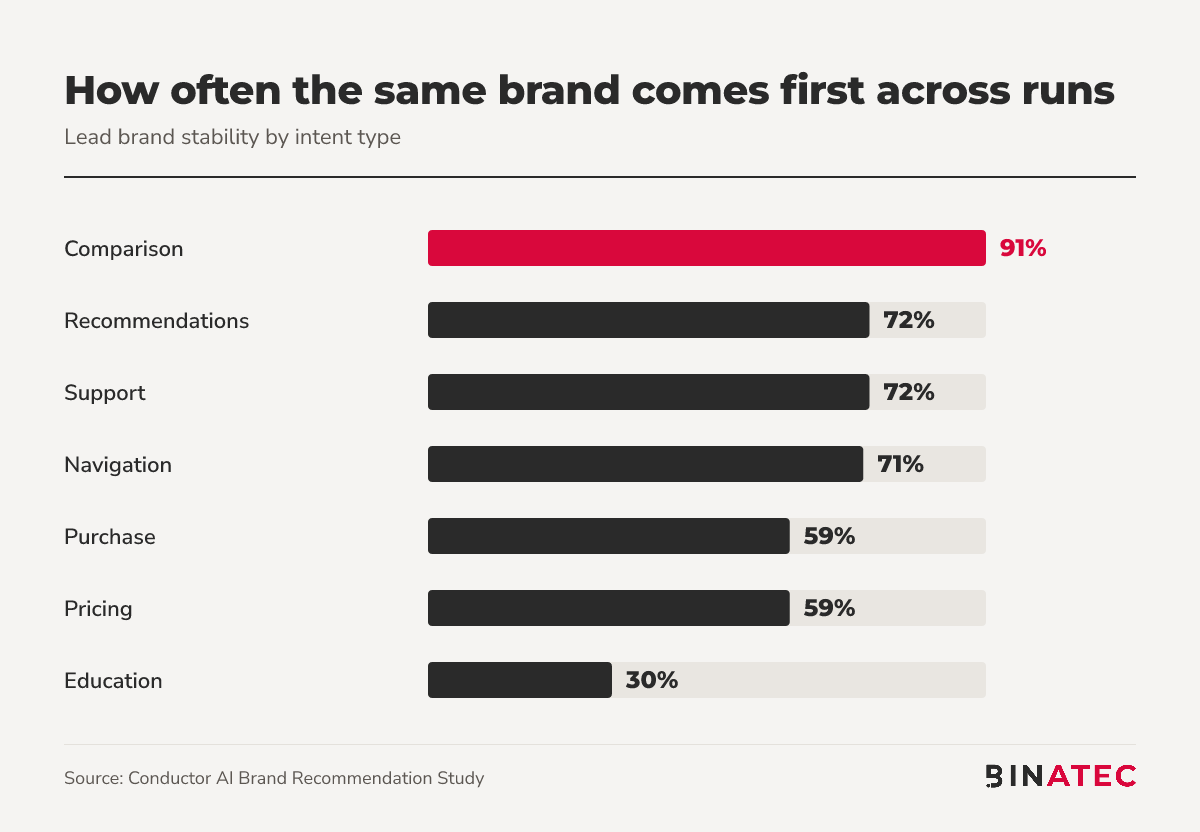
There's a second twist on educational prompts. Conductor found that between 45% and 72% of them returned no brand names at all, depending on the engine. For pricing questions, 20% of responses named no brands.
So for "how do I" and "what is" questions, AI often answers with no brand in sight. Your goal there isn't a mention. It's being the source the answer is built from.

What the Recommendation Questions Reveal
Recommendation prompts ("what's the best option for…") showed something useful. Certain brands appeared in 90% to 100% of runs across all four engines, per the study.
In insurance, State Farm, USAA, Allstate and Progressive showed up in 83% to 93% of recommendation runs. In cloud computing, four brands appeared in more than 80% of them.
The pattern is clear. Once a brand becomes a default answer, it tends to stay one. If you're not on that short list yet, you're competing for the few remaining slots.
Do the Engines Behave the Same Way?
Not quite. According to the study, ChatGPT was the most consistent and named the fewest brands, averaging 5 per response. Gemini was the least consistent and named the most, averaging 9.2. Perplexity averaged 8.3 and Claude 8.5.
ChatGPT led on knowledge-based intents such as comparison, education, navigation and support. Perplexity led on transactional ones: pricing, recommendations and purchase.
That means one tool's answer can't stand in for all of them. Where your buyers ask matters as much as what they ask.
How to Test Your Own Brand This Week
You don't need a big budget. You need a repeatable routine.
Here's a simple version:
- Write 3 questions for each intent type your buyers use: a comparison, a pricing question, a "what's best" question, a how-to and a ready-to-buy question.
- Run each question several times in each AI tool your customers use, using a fresh chat every time.
- Record whether your brand is named, where it sits in the list, and which competitors appear.
- Repeat weekly for a month so you can see the range, not a single snapshot.
- Group the results by question type, not just in one total score.
Search Engine Land's coverage of related research also notes that brand recommendations vary by platform and by week, which is one more reason to look at trends instead of one-off checks.
What This Looks Like in Practice
Take a hypothetical accounting software company. It runs its checks and finds a pattern like this.
- Comparison questions: a rival leads almost every time. The fix is a fair, detailed comparison page and third-party reviews that put the brand in that conversation.
- Educational questions: no brand is named. The fix is clear, well-sourced guides that AI can draw from.
- Purchase questions: the brand appears in some runs, not others. The fix is stronger signals everywhere buyers look, like reviews, listings and consistent product details.
Same company, three different jobs. That's the real value of splitting results by intent. It tells you where to spend your next hour of content effort.
If this sounds like a lot to track by hand, our AI brand visibility audit does exactly this, and our GEO optimisation work acts on what turns up.
Where This Research Breaks Down
Be honest about the limits. The study used standardised prompts and stateless runs, so it doesn't capture how real people chat, follow up or use personalised settings.
It's also one vendor's study, and it disagrees with an earlier one. Neither settles the question.
And AI answers are only one route to a sale. Your site, your Google presence and your reputation still do most of the work once someone is interested. Use this research to sharpen your content plan, not to rebuild your whole strategy around chatbots.
FAQs
Why does AI give different brand answers to the same question?
AI answers are generated fresh each time, so the list of brands can shift between runs. Conductor's study found the shift is biggest for purchase questions, where only 40% of brands overlapped between two runs of the same prompt.
Which type of question is the best one to win?
Comparison questions are the most decisive, because one brand led 91% of the time in the study. If a buyer is weighing you against a rival, being the default comparison pick is worth the most.
How many times should I test a prompt?
More than once. Conductor ran each prompt 50 times to measure consistency. You don't need that many, but several runs per prompt, repeated weekly, give you a far truer picture than a single check.
Does industry size decide whether AI names my brand?
Conductor says intent matters more than industry. An earlier January 2026 SparkToro study reached the opposite view, so the evidence is mixed. Test your own category rather than assuming.
Conclusion
The idea to remember: AI doesn't have one opinion of your brand. It has a different answer for every kind of question, and you can only improve what you measure by question type.
This week, write down 15 questions your buyers would ask, split them by intent, and run each a few times. You'll quickly see where you're missing.
If you'd like help turning those results into a plan, get a free quote and we'll take a look together.
Sources
- Conductor: AI Brand Recommendation Study, Why Intent Type Predicts AI Output Consistency
- Search Engine Land: AI brand recommendations vary by platform and week


John Doe
Supreb Information. Thanks
15 July 2014 View replies . 1