



What is conversion rate optimization? Learn what CRO means, how to calculate your rate, what a good one looks like, and the 6-step process to raise it.
Are you paying for traffic every month, watching the visitor numbers climb, and still wondering why the enquiries and sales barely move?
You're not alone. Most businesses respond to flat results by buying more clicks. It feels logical, but it's the most expensive way to grow.
There's a cheaper lever, and it's called conversion rate optimization. Sound familiar? Maybe you've heard the term in an agency pitch and nodded along without being sure what it covers.
This guide explains what CRO is in plain English, how to calculate your own rate, what a realistic benchmark looks like, and the process to follow so changes actually pay off.
Conversion rate optimization (CRO) is the ongoing process of improving your website so a higher share of visitors complete a goal, such as buying, booking a call or requesting a quote. You find where people drop off, test a fix, keep what works and repeat. The aim is more revenue from the traffic you already have.
Key Takeaways
- Conversion rate is conversions divided by visitors, multiplied by 100, so 50 sales from 1,000 visitors is a 5% rate.
- Benchmarks vary widely by industry, so compare yourself with businesses like yours, not a single 'average' number.
- Baymard's review of 50 studies puts average cart abandonment at 70.22%, so most shoppers who start buying never finish.
- Desktop visitors convert far more often than mobile visitors in Visionary Marketing's 2026 data, so mobile is often the first leak to fix.
- CRO works best as a loop of research, hypothesis, test and repeat, not a one-off redesign.
- Raising your rate from 2% to 3% on 10,000 visitors means 100 extra conversions without spending more on traffic.
What Is Conversion Rate Optimization?
Shopify describes CRO as a data-driven, iterative process: analyse how people behave, find the friction, test a change and repeat the cycle as new data arrives.
A 'conversion' is whatever action matters to your business. For a shop it's a purchase. For a service business it might be a quote request, a phone call or a demo booking. It can also be a smaller step, like an email signup.
That's the whole idea. CRO isn't about making your site prettier. It's about making it easier for the right people to say yes.
How Do You Calculate Your Conversion Rate?
The formula is simple. Divide the number of conversions by the number of visitors, then multiply by 100. Both Shopify and Lucky Orange give the same one.
Work it out in three steps:
- Pick one goal, for example completed purchases or submitted quote forms.
- Count how many times it happened in a period, say the last 30 days.
- Divide by the visitors (or sessions) in the same period and multiply by 100.
Shopify's own example: 50 sales from 1,000 visitors gives a 5% conversion rate. Track it per page type, per device and per traffic source, because one blended number hides the real problems.

What Is a Good Conversion Rate?
It depends on your industry, your offer and your traffic. Visionary Marketing's 2026 benchmark report puts the all-industry average at 2.9% with a median of 2.4%. Its sectors range from legal services at 7.4% and education at 6.1% down to online retail at 2.2% and manufacturing at 2.1%.
Ecommerce sits in the middle. Shopify cites Dynamic Yield for a global ecommerce average of 2.72% over the past 12 months.
Treat these as rough guides. Methods and definitions differ between studies, and many pages online simply repeat each other. The only benchmark that really matters is your own rate last quarter.
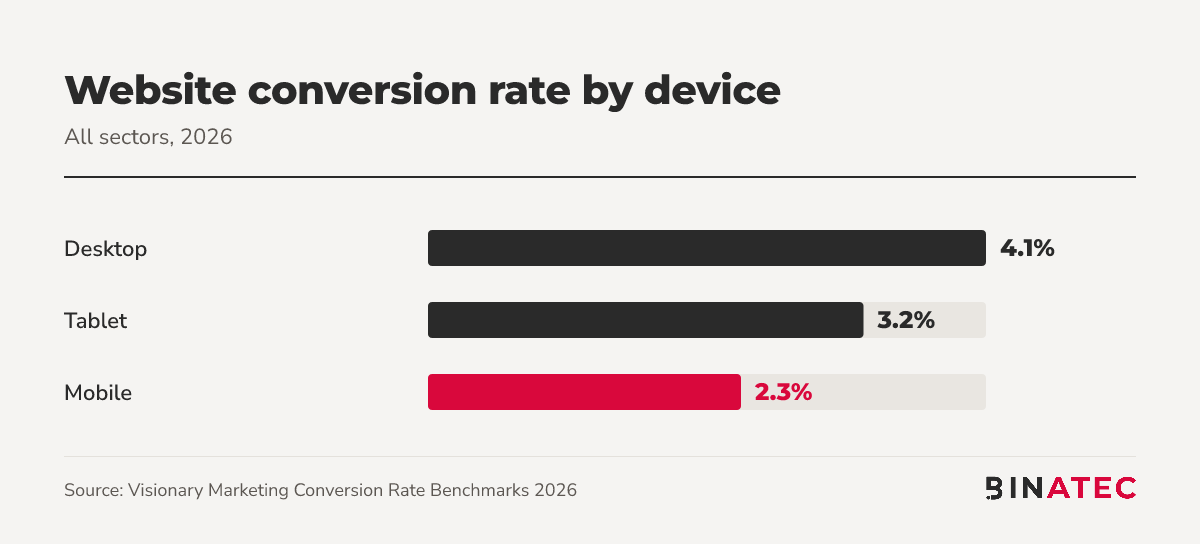
Notice the gap. Mobile converts at 2.3% against 4.1% on desktop in that same report, and Shopify cites Statista saying more than 62% of global web traffic comes from smartphones and tablets. Your biggest audience is often your weakest-converting one.
Why CRO Beats Buying More Traffic
Take Lucky Orange's illustration: 10,000 visitors converting at 2% gives 200 conversions, and at 3% gives 300. That's 50% more results from the same visitors and the same ad spend.
It also lowers what each customer costs you. The same budget now produces more customers, so your cost per acquisition falls.
CRO and SEO or ads work as a pair. Traffic work fills the funnel, and CRO stops it leaking. If you invest in one without the other, you either pay for visitors who leave or build a great page nobody sees. Our conversion rate optimisation and SEO teams plan the two together.
The 6-Step CRO Process
Shopify's process boils down to six moves. Here they are with what to do at each.
Step 1: Set Your Baseline
Calculate your current rate for your main goal, split by device and source. You can't prove improvement without a starting number.
Step 2: Find the Friction
Combine numbers with behaviour. Analytics shows where people leave. Heatmaps and session recordings show why. Short surveys and customer calls fill the gaps. Our heatmap and session analysis service does exactly this.
Step 3: Write a Hypothesis
State the change and the expected result: 'Showing total cost on the product page will cut checkout drop-off, because shoppers hate surprise fees.' A vague idea isn't a test.
Step 4: Prioritise
Shopify suggests the PIE framework: score each idea on Potential, Importance and Ease. Fix high-traffic, high-drop-off pages that take little effort first.
Step 5: Test It
Run an A/B test, showing half your visitors the current page and half the change. Lucky Orange says tests typically need two to four weeks to reach significance, though it gives no source, so judge by your traffic. Low-traffic sites may need bigger changes or before-and-after comparisons.
Step 6: Roll Out and Repeat
Keep the winner, learn from the losers and move to the next idea. Each cycle teaches you something about your customers.
Where Do Most Sites Lose Visitors?
In ecommerce, the checkout is the usual suspect. Baymard's list of 50 studies, last updated September 2025, puts average cart abandonment at 70.22%.
Its list of reasons (for shoppers who weren't just browsing) is a ready-made to-do list:
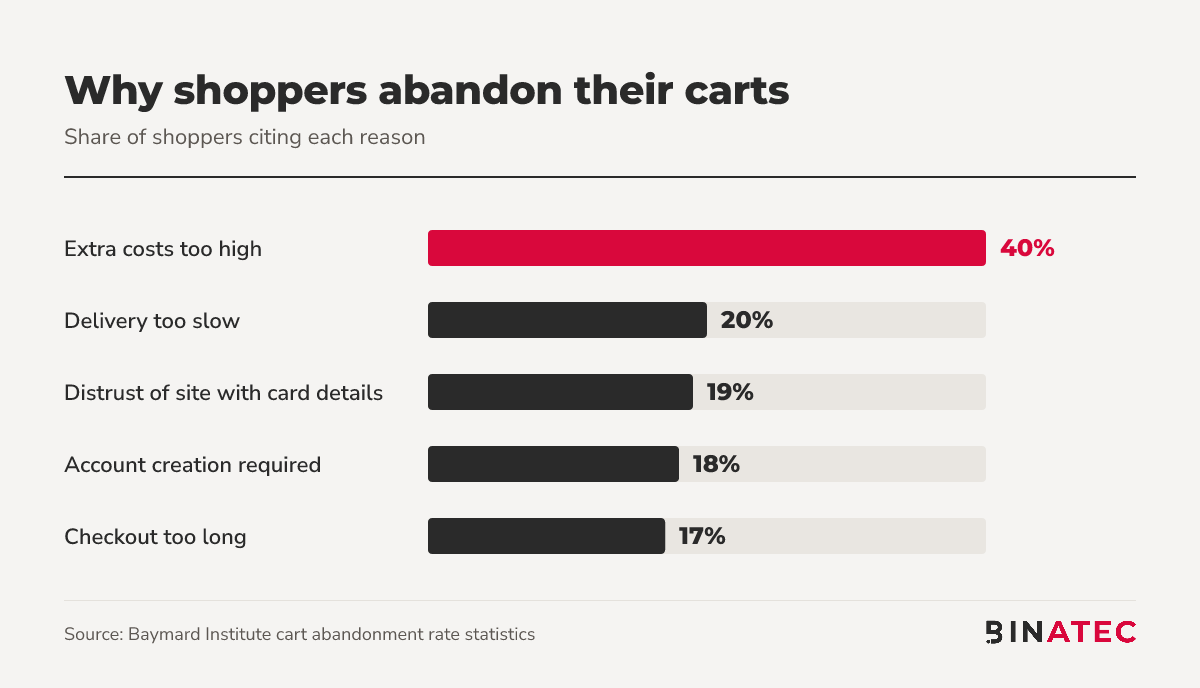
Two of those, forced account creation and a long checkout, cost you nothing to fix. Showing total cost early also addresses the biggest reason on the list.
Service businesses leak elsewhere: a vague headline, a long form, no proof, a slow mobile page. If you want to see where your own site stands, our landing pages and funnels team can walk through it with you.
CRO in Action: A Quick Example
Here's a worked example using Shopify's own figures. A store gets 10,000 visits a month at a 2% rate, so 200 orders. Say it cuts a checkout step and shows shipping costs upfront, and the rate moves to 2.5%.
That's 250 orders, 50 more every month, from the same ad budget. This is an illustration with made-up numbers, not a promise of results, but it shows why small percentage gains matter.
For a real-world case, Lucky Orange reports that Interplay Learning lifted its demo signup conversion from 6% to 17% after optimising.
When CRO Isn't the Answer
CRO needs enough visitors to learn from. If your site gets only a few hundred visits a month, split tests will take forever. Fix the obvious problems, then work on traffic first.
It also can't rescue a weak offer. If nobody wants what you sell at your price, a better button won't help. And chasing a rate alone can mislead you: a free-trial page might convert more people who never buy. Track revenue, not just clicks.
FAQs
What does CRO mean in digital marketing?
CRO stands for conversion rate optimization. In digital marketing it means improving your website, landing pages or checkout so more of your visitors take a valuable action, such as buying, subscribing or booking a call, without needing extra traffic.
What is a good conversion rate?
It varies by industry. Visionary Marketing's 2026 report puts the all-industry average at 2.9% with a median of 2.4%, while sectors like legal services reach 7.4%. Compare your rate with similar businesses and your own history.
How long does CRO take to show results?
Simple fixes like clearer calls to action or shorter forms can show results within weeks. Formal A/B tests typically run two to four weeks each, per Lucky Orange. Real compounding gains come from running test cycles steadily over months.
What is the difference between CRO and SEO?
SEO brings more of the right people to your site from search. CRO turns more of the people already there into customers or leads. They work best together: SEO supplies visitors, CRO converts them.
What tools do I need for CRO?
At minimum, an analytics tool such as GA4 to measure conversions, a heatmap or session recording tool to see behaviour, and an A/B testing tool for experiments. Add on-page surveys when you want to hear directly from visitors.
Conclusion
Conversion rate optimization comes down to one idea: get more customers from the visitors you already pay for. Measure the rate, find the leak, test a fix and repeat.
This week, calculate your conversion rate by device. If mobile is far behind desktop, start there.
If you'd like a second pair of eyes on where your site is leaking, you can get a free quote and we'll take a look.
Sources
- Conversion Rate Optimization (CRO): Get Started (2026), Shopify
- Conversion Rate Optimization: The Complete Guide (2026), Lucky Orange
- Conversion Rate Benchmarks 2026, Visionary Marketing
- Cart Abandonment Rate Statistics, Baymard Institute


John Doe
Supreb Information. Thanks
15 July 2014 View replies . 1